Hello people! The start of the short rains out here in the Mara have given me the time to finally contribute some material to this blog. In all honesty, I've certainly had the time to do this sooner, so lets just say that the short rains have brought on a new level of boredom that has allowed me to expand upon -what some may call- my routine out here.
The month of October consisted of a healthy amount of rain. There were quite a few times where we couldn't go out due to the rain, but nothing like this. I think in the last 3 days, we've gone out for a total of 45 minutes. I never thought I would get bored of sleeping in, but it has happened. So what have we been doing to pass the time? Lots of reading, and I know Dave and Julia have been doing work on their own research, but I think that I speak on behalf of the group here when I say that the climax of the days events is when we put aside all personal endeavors and break out the game of games - Settlers of Catan. Its a board game consisting of building roads and cities, trading resources, and teaming up against the person who is winning (aka Dave). They told me it was addicting when they taught me how to play... and they were right. Even now, as I'm sitting here writing this blog, I'm praying that Dave and Julia put aside their real people work for an hour and so that I can get my fix.
Its all made worse by the fact that I haven't even won a game yet. Hopefully that changes soon, or the month of November is going to be overcast in more than one way.
Saturday, November 3, 2012


Sunday, September 23, 2012
Elephant Roadblock
Dear Elephants,
Look, I get it. You're huge. So huge in fact, that you can stop traffic and prevent cars like my own from going a certain way.
That's OK, I'm familiar with your ways. In fact when training new researchers on driving through roundabouts in Nairobi, I always say, "cars in the roundabout always have the right of way, unless they're bigger than you." Same rules must apply in the Mara too, I guess.
Point taken.
Elephants: 1
David: 0
At any rate, I'm glad to see you're back in the Mara after your exodus to avoid the migration.
Xoxo,
David
Look, I get it. You're huge. So huge in fact, that you can stop traffic and prevent cars like my own from going a certain way.
That's OK, I'm familiar with your ways. In fact when training new researchers on driving through roundabouts in Nairobi, I always say, "cars in the roundabout always have the right of way, unless they're bigger than you." Same rules must apply in the Mara too, I guess.
Point taken.
Elephants: 1
David: 0
At any rate, I'm glad to see you're back in the Mara after your exodus to avoid the migration.
Xoxo,
David
Thursday, August 2, 2012
An ode to Target and Welcoming Junior
In memory of Target, Dee sent me a picture of Target dressed in MSU hyena research swag, and Kay’s jacket. Thank you, Target, for braving all the crazy hyenas who try to attack your face.

But now we have Junior, who is in much better shape.
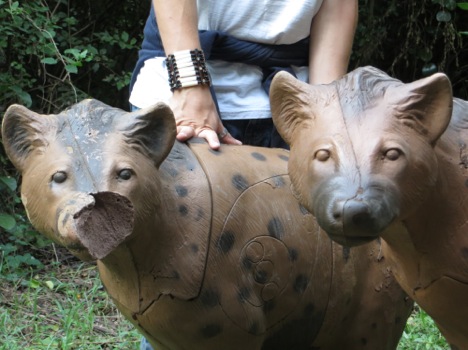
Unfortunately, recently the hyenas have been pretty quiet, so I haven’t had many opportunities to throw Junior out into the wild. This is the nature of field work; the animals don’t always do what you want them to.
Since Junior has arrived, he has seen some action, but luckily nothing like what Target saw. This morning, I had a near heart attack though, when Artemis bolted at Junior. Flashing through my head was, “Oh my gosh, how do I rescue Junior?!? Artemis is running so fast! AAAAH!” Luckily for Junior and me, she stopped abruptly about 10m away from Junior.

Since I am about to leave for the summer, this is probably one of Junior’s last outings until I am back next year or someone else has a good idea for Junior to do.
Friday, July 20, 2012
What do we do with all this poop?
Whenever we see one of our hyenas doin’ its business, we try to collect a fecal sample. This may strike you as pretty disgusting (and indeed, it sometimes is), but poop can provide us with a wealth of information about the inner workings of hyenas. We can use a small sample to measure a variety of hormone levels and even extract DNA to determine their genetic relatedness to other individuals. Because physiological changes can be a warning sign of impending population declines, as David Green described in a recent post, we are also planning to explore what stress hormone levels in hyena poop can signal about the status of mammals in the Mara ecosystem (for more on this, and for opportunities to help through our sponsorship by Petridish, check out http://www.petridish.org/projects/a-sentinel-for-african-ecosystems). All of this makes us hyena researchers quite excited when we see a study subject dropping us one of these treasured morsels, can locate it in the grass, get it into a ziplock bag in the field, and then stuff it into vials that are frozen in liquid nitrogen back at camp.
But the road from watching a hyena poop to having usable data is a long one. This spring, before heading out to the Mara for my two-year field season, fellow grad student Sarah Jones and I packed up about 550 hyena fecal samples and headed to the University of Nebraska to see what our hyenas’ various bowel movements over the past six years or so could tell us. Sarah was analyzing samples for androgen levels (a class of hormones including testosterone). I analyzed samples for corticosterone – a main mammalian stress hormone.
After our precious cargo made it safely to Omaha (driving around with a back seat full of coolers of valuable poop is a bit unnerving), we learned from endocrine god Dr. Jeff French how to transform our stinky poop samples into PhD gold. Dr. French normally spends his time exploring the connections between hormones and behavior in marmoset monkeys and humans but takes a break every few years to help us process these more exotic poops transported all the way from the wilds of Africa.
Before even doing hormone assays to determine the concentrations of hormones in our samples, we first had to extract the hormone from the feces. This proved the most labor-intensive part of the whole process and amounted to about five days of thawing poop, weighing poop, heating poop, drying poop, grinding poop with a mortar and pestle, picking hairs out of poop, and…weighing it again. The goal is to get a pure sample of dried feces that, when combined in a known mass with a known volume of liquid, will give us a homogenous solution of hormones. Here are some of the steps we went through to turn hyena diarrhea into some pretty science-y looking tubes of extracted hormone…


 \
\
In the beginning, this process was super cool to me. Five years after some hyena ate a zebra, here I was sitting in Nebraska seeing all those tiny black and white hairs in its poop and picking them out with the attention of a surgeon. But after doing this for more or less 12 hours a day, Sarah and I were starting to think our morning coffee grounds looked like poop (and wow, so perfectly mortared-and-pesteled!) and had the urge to weigh out a perfect .2 grams of that pepper before adding it our pasta. We were ready to reach the end of the extracting phase….


Voila! We do some chemistry and centrifuging magic with those dried samples and here’s that solution of hormones on the left. The rest of the stuff in our sample – all the stuff we don’t want – remains in the tube on the right.


After using some more fancy science tools that us field biologists don’t usually lay our hands on, like this multi-channel pipetter on the left, we are left with our final extracted product on the right. I swear, these little holders filled with just the precise quantity of yellowish sample, perfectly in solution, looked more beautiful than liquid gold. Now, on to the exciting part…finding out the concentration of corticosterone in each of those little tubes. This will help us determine how a hyena’s stress level is shaped by ecological, social, and physiological factors, as well as conservation management decisions.
And for this, us field folk get to feel even more like real, honest-to-god scientists by utilizing the properties of radioactive substances. We add an antibody to our extracted hormone as well as corticosterone tagged with a radioactive Iodine tracer. What this amounts to in the lab is adding various brightly-colored radioactive liquids to our precious tubes of extracted hormone in specific timed succession, giving us pretty test-tube racks like this…

Then, the hormone in our sample and this radioactive antigen compete for binding sights on the antibody. This is one of the highlights of the process because as the magic of “competitive binding” occurs within each of these tubes, you get to take a 2-hr break from pipetting and go grab some lunch. When you return, chemistry magic has happened… and I have never been this excited about basic chemistry principles in my life. We can then add another brightly colored liquid to our tubes to separate the radioactive-labeled hormone that has bound to the antibody from the hormone that has not. After adding this precipitant and centrifuging our tubes, we’ve successfully completed this separation.

And finally comes the most nerve-wracking step of the entire procedure…decanting. Imagine, after spending days extracting the hormones, and then many hours carefully pipetting small amounts of somewhat dangerous substances in and out of small containers, you manage to get each of these precious tubes safely in and out of the massive centrifuge. You’ve also managed to not spill anything and are trying not to think about just how much each of these little tubes actually costs if you were to sum up the price of all the different liquids you’ve added. Now comes the time when you put these tubes in a special holder, turn them upside down, and literally pour all the fancy chemicals you’ve added down the drain. For me, this was the most stressful step in the process. I always had a mental flash of all those valuable tubes crashing into the sink and having to start the whole thing over again!

...but not everything goes down the drain. What we are left with is a small pellet in each tube that can be read in a Gamma Counter to measure the amount of radioactivity. The higher the radioactivity, the more the radioactive hormone won out in our competitive binding battle and the less corticosterone there actually is in our fecal sample. By comparing our samples with various solutions of known standard concentration, we can determine precisely the amount of stress hormone in each of our samples.
In the coming months, we will be using these new data to address several questions in addition to the hypothesis that spotted hyenas can serve as an "indicator species" for the Mara ecosystem. For example, I will be asking whether hyenas living in areas within the Mara with different management strategies show different stress profiles. I will also be looking at the behavioral, physiological, and demographic consequences of maternal stress for mother-offspring relations and cub development. As these questions form the heart of my PhD research, you'll hear more about them in future blog posts...
My first foray into endocrine lab work would not have been possible without the help of the French Lab. Thanks to Dr. French for opening his doors to smelly hyena poop samples and all his guidance. Also, thanks to undergrad Benjamin Hochfelder in the French lab. Can you believe Ben came in on a weekend to help us grind and weigh poop!? Finally, Sarah and I want to give a huge thank you to Drew Bernie. Drew’s title is “lab tech” but his endless help and trouble-shooting abilities during our stay in Omaha quickly earned him the nickname “Superman.” Drew turned me from a pipette-naïve hyena watcher into an assay-machine and seemed to be able to put out any fire that Sarah and I started. Thanks, Drew!


Left: undergrad-extraordinaire Ben Hochfelder
Right: Drew didn’t want a commemorative photograph taken, but this picture pretty much sums him up.
But the road from watching a hyena poop to having usable data is a long one. This spring, before heading out to the Mara for my two-year field season, fellow grad student Sarah Jones and I packed up about 550 hyena fecal samples and headed to the University of Nebraska to see what our hyenas’ various bowel movements over the past six years or so could tell us. Sarah was analyzing samples for androgen levels (a class of hormones including testosterone). I analyzed samples for corticosterone – a main mammalian stress hormone.
After our precious cargo made it safely to Omaha (driving around with a back seat full of coolers of valuable poop is a bit unnerving), we learned from endocrine god Dr. Jeff French how to transform our stinky poop samples into PhD gold. Dr. French normally spends his time exploring the connections between hormones and behavior in marmoset monkeys and humans but takes a break every few years to help us process these more exotic poops transported all the way from the wilds of Africa.
Before even doing hormone assays to determine the concentrations of hormones in our samples, we first had to extract the hormone from the feces. This proved the most labor-intensive part of the whole process and amounted to about five days of thawing poop, weighing poop, heating poop, drying poop, grinding poop with a mortar and pestle, picking hairs out of poop, and…weighing it again. The goal is to get a pure sample of dried feces that, when combined in a known mass with a known volume of liquid, will give us a homogenous solution of hormones. Here are some of the steps we went through to turn hyena diarrhea into some pretty science-y looking tubes of extracted hormone…


Weighing out a precise quantity of feces

Drying out a hundred-or-so fecal samples overnight in an incubator
 \
\
DO NOT drop this tray of incubated samples! Aren’t they colorful!? Dr. French and I think they look like spices set out in a Middle Eastern market.
In the beginning, this process was super cool to me. Five years after some hyena ate a zebra, here I was sitting in Nebraska seeing all those tiny black and white hairs in its poop and picking them out with the attention of a surgeon. But after doing this for more or less 12 hours a day, Sarah and I were starting to think our morning coffee grounds looked like poop (and wow, so perfectly mortared-and-pesteled!) and had the urge to weigh out a perfect .2 grams of that pepper before adding it our pasta. We were ready to reach the end of the extracting phase….


Voila! We do some chemistry and centrifuging magic with those dried samples and here’s that solution of hormones on the left. The rest of the stuff in our sample – all the stuff we don’t want – remains in the tube on the right.


After using some more fancy science tools that us field biologists don’t usually lay our hands on, like this multi-channel pipetter on the left, we are left with our final extracted product on the right. I swear, these little holders filled with just the precise quantity of yellowish sample, perfectly in solution, looked more beautiful than liquid gold. Now, on to the exciting part…finding out the concentration of corticosterone in each of those little tubes. This will help us determine how a hyena’s stress level is shaped by ecological, social, and physiological factors, as well as conservation management decisions.
And for this, us field folk get to feel even more like real, honest-to-god scientists by utilizing the properties of radioactive substances. We add an antibody to our extracted hormone as well as corticosterone tagged with a radioactive Iodine tracer. What this amounts to in the lab is adding various brightly-colored radioactive liquids to our precious tubes of extracted hormone in specific timed succession, giving us pretty test-tube racks like this…

Radioactive poop!
Then, the hormone in our sample and this radioactive antigen compete for binding sights on the antibody. This is one of the highlights of the process because as the magic of “competitive binding” occurs within each of these tubes, you get to take a 2-hr break from pipetting and go grab some lunch. When you return, chemistry magic has happened… and I have never been this excited about basic chemistry principles in my life. We can then add another brightly colored liquid to our tubes to separate the radioactive-labeled hormone that has bound to the antibody from the hormone that has not. After adding this precipitant and centrifuging our tubes, we’ve successfully completed this separation.

Tubes of radioactive poop about to be centrifuged
And finally comes the most nerve-wracking step of the entire procedure…decanting. Imagine, after spending days extracting the hormones, and then many hours carefully pipetting small amounts of somewhat dangerous substances in and out of small containers, you manage to get each of these precious tubes safely in and out of the massive centrifuge. You’ve also managed to not spill anything and are trying not to think about just how much each of these little tubes actually costs if you were to sum up the price of all the different liquids you’ve added. Now comes the time when you put these tubes in a special holder, turn them upside down, and literally pour all the fancy chemicals you’ve added down the drain. For me, this was the most stressful step in the process. I always had a mental flash of all those valuable tubes crashing into the sink and having to start the whole thing over again!

Pouring it all down the drain...
...but not everything goes down the drain. What we are left with is a small pellet in each tube that can be read in a Gamma Counter to measure the amount of radioactivity. The higher the radioactivity, the more the radioactive hormone won out in our competitive binding battle and the less corticosterone there actually is in our fecal sample. By comparing our samples with various solutions of known standard concentration, we can determine precisely the amount of stress hormone in each of our samples.
In the coming months, we will be using these new data to address several questions in addition to the hypothesis that spotted hyenas can serve as an "indicator species" for the Mara ecosystem. For example, I will be asking whether hyenas living in areas within the Mara with different management strategies show different stress profiles. I will also be looking at the behavioral, physiological, and demographic consequences of maternal stress for mother-offspring relations and cub development. As these questions form the heart of my PhD research, you'll hear more about them in future blog posts...
My first foray into endocrine lab work would not have been possible without the help of the French Lab. Thanks to Dr. French for opening his doors to smelly hyena poop samples and all his guidance. Also, thanks to undergrad Benjamin Hochfelder in the French lab. Can you believe Ben came in on a weekend to help us grind and weigh poop!? Finally, Sarah and I want to give a huge thank you to Drew Bernie. Drew’s title is “lab tech” but his endless help and trouble-shooting abilities during our stay in Omaha quickly earned him the nickname “Superman.” Drew turned me from a pipette-naïve hyena watcher into an assay-machine and seemed to be able to put out any fire that Sarah and I started. Thanks, Drew!


Left: undergrad-extraordinaire Ben Hochfelder
Right: Drew didn’t want a commemorative photograph taken, but this picture pretty much sums him up.
Wednesday, July 11, 2012
Tall Grass be Gone!
Here in the Mara Triangle, the lack of grazing and extended long rains in April has made for some really tall grass.
Like REALLY tall. Upwards of six feet in some places.
Luckily, The Mara Conservancy has cut the grass on tracks in preparation for the high season and flood of tourists. Unfortunately in a small car like the Maruti, our car wanted to bring some back from the bush as a souvenir for camp!
Like REALLY tall. Upwards of six feet in some places.
Luckily, The Mara Conservancy has cut the grass on tracks in preparation for the high season and flood of tourists. Unfortunately in a small car like the Maruti, our car wanted to bring some back from the bush as a souvenir for camp!
Wednesday, July 4, 2012
A Sentinel for African Ecosystems and an Opportunity to Help
An up and
coming website called Petridish is giving us the opportunity to raise funds for
research, not from big granting agencies, but from ordinary people like you.
Below is a general synopsis of the project, but for more information and ways
to donate go to http://www.petridish.org/projects/a-sentinel-for-african-ecosystems.
Monitoring
an entire ecosystem is an incredibly daunting task. There are many species of
sympatric herbivores and carnivores, important ecological processes taking
place, and interactions between all three that maintain and sustain ecosystem
functioning. If disturbed, the ecosystem (and species within it) may become
threatened, endangered, and risk extinction.
Although sentinel
and indicator species have been monitored to prevent damage to ecosystems and
specific species, they have historically been used on a presence/absence basis. In other words, if the indicator species
(i.e. spotted owl) is present in an ecosystem, then the ecosystem is deemed to
be in “good” condition, or recovering from previous disturbances.
Unfortunately,
by thinking of an indicator species only from a presence/absence basis, we may
be ignoring subtle cues emitted by good sentinels to help prevent damage to
ecosystems and other sensitive species. By using a species that is known to
emit subtle cues, we may be able to curb disturbances before it becomes too
late. And this is where the spotted hyenas come in!
Previous
research in our lab has shown spotted hyenas to emit early warning signals
about how they themselves are negatively influenced by human encroachment on
their habitat. Changes in space use behavior, often one of the first ways that
organisms adjust to changing environments, pre-date demographic changes in
hyenas by 3 years. Changes in
stress physiology, another signal that a population could be in trouble,
pre-date demographic changes in hyenas by 5 years. What we want to understand
with this new research program is if these same metrics can be used to predict
population changes in more sensitive species in African ecosystems, like lions,
cheetahs, and threatened herbivores.
To evaluate the
hyena’s capability to act as an indicator species, we will use GPS collar
technology to look at how hyenas utilize space, monitor stress physiology
through non-invasive collection of feces, and then relate these measures to the
spatial patterns and population trends of other carnivores and herbivores that
live in our hyenas’ territories. This may sound easy, but it will require
deploying new collars to many of our study animals, and months of driving
around our territories to effectively monitor multiple animals on the
landscape. However, the payoff will be extraordinary if we are able to use
changes in our hyenas to aid in the conservation of biodiversity!
To learn
more about this exciting research, and to help support and donate to its completion,
please see more at http://www.petridish.org/projects/a-sentinel-for-african-ecosystems.
Petridish.org
is a great site that allows readers and hyena enthusiasts (like yourself!) to
get involved with research taking place around the globe. Please go to the
website and learn more about using spotted hyenas as a sentinel for African
ecosystems, and think about donating. Every little bit helps!
Tuesday, July 3, 2012
Pan ate Target!
While in Talek, I have been doing experiments to test an individual hyena’s boldness. We have this foam hyena that we call Target that I have been showing to hyenas to see how they respond.

Alfredo and Target
Most hyenas who have seen Target will notice it, try to get downwind of it to smell it, maybe head bob to it, and leave. There are a few variations to this pattern, but we think that the hyenas eventually realize that Target is not a hyena as they get closer.
A couple days ago, I saw the two most extreme responses yet.
In the morning, we showed Target to Blue, an adult female. She is relatively high ranking. Blue was very upset by Target. We had placed Target in the road she was going down, and once she saw Target, she stopped dead. Slowly, Blue got a little closer to Target. By the time she was barely 30m away from Target, she turned around, walked over 100m away, walked around Target putting our car between her and Target, then continued down the road. Blue didn’t really even bother to try to sniff out what it was; she just avoided it.
In the evening, we were lucky enough to find another test subject. It was Morpheus, a higher ranking female than Blue. Morpheus saw Target, stopped briefly to stare at it, then walked straight up to it. She was the first hyena I have seen to touch Target. If someone goes close, they’re still usually about 5m away. Morpheus was walking circles around Target, sniffing and licking it. All the sudden, she stopped abruptly and walked off, and we realized that her younger sister, Pan, was coming straight at Target with another older sister, Adonis, hanging back about 80m. For the second time ever, we watched a hyena walk straight up to Target and start sniffing and licking her. Next thing we knew, Pan had grabbed Target’s tail, dragged her a couple meters, and knocked her off her stand. Adonis started to approach from where she was hanging back with her daughter, Grape Escape, at this time, and Pan started to drag Target into the grass. This series of events all happened very quickly, and once Pan started taking Target into the grass, we stopped the session immediately to go save Target.
Unfortunately, we were a bit too late. Within the 30 seconds it took to drive to where they were, Pan had bitten a few bites out of Target’s rump, detached its head (which is meant to slide off), and bitten off about half of her nose. Poor Target. One of the weird things is that the parts that were bitten are the exact places hyenas would attack an intruder. So maybe they think Target is a hyena, or at least enough hyena-like, longer than we had thought. Or this could just be the case for these high ranking and bold sisters.

Target’s injuries, with Jenna looking shocked and worried in the background

Ian (one of the IRES students) and me with Target in the beautiful Hilux
Thursday, June 28, 2012
Be a Part of Hyena Research!
For those of you loyal followers (readers who check this
here blog more than once a day), and those new to the Mara Hyena Project (those
of you who have recently been hooked on our “Notes From Kenya” blog), we want to
get YOU involved in the research!
To do this, we’ve created some new t-shirts that allow you
to help support our research efforts while also looking shnazzy!
Take a look at these fine researchers and staff sporting the new t-shirts!

Photo of researchers, staff, and Dr. Kay Holekamp in the new threads.
The best part is that you too can look as shnazzy as them!
Just email Dee White at dwwhite99@aol.com for more information. Hope to see YOU
rocking our hyena prints soon!
Saturday, June 9, 2012
Meet the new girl.
Our newest research assistant is Jenna Parker, who first came to Kenya with our 2009 BEAM class. As I did many years ago, Jenna has clearly fallen in love with the Mara and our hyenas. She returned to the project during the summer of 2011 as an IRES student, where she did a project identifying lions individually by their whisker spots. And now she's here for the year, taking over for Eli Strauss when he heads home at the end of June. It is not clear whether Jenna will be contributing to this blog during the coming year, but she has her own blog on which she reports on events here in Kenya, so if you're interested in reading those posts, they can be found at

kenyasummer.blogspot.com
Here's Jenna babysitting an immobilized hyena en route to our "recovery bush."

Lion dummies
A lot of folks have inquired lately about what’s going on
over here, perhaps because there have been so few contributions to this blog
lately. In fact, we’ve been extremely busy doing loads of different things
here, but this week in particular has been exciting because we’ve been doing
pilot experiments looking at hyena responses to life-sized stuffed lions. The
stuffed lions are on loan to us from Craig Packer’s lab; one of his graduate
students working on inter-specific relationships among large carnivores, Ali
Swanson, brought them up to us from Serengeti a few days ago. These lions had
been used several years ago when Packer and colleagues were inquiring why lions
have manes, but encounters between the fake and real lions in those experiments
caused the stuffed lions to suffer some wounds. Therefore, upon Ali’s arrival
at fisicamp, our first task was to repair some of the damage inflicted on the
stuffed lions by their real counterparts. Although Ali and I initiated the
repair work, both Josephs and the other guys who work in our camp soon took
over patching various holes in the stuffed lions. Stephanie Dloniak flew down to
the Mara with her sound equipment so we could call hyenas in to interact with
the stuffed lions.


My goals in asking Craig & Ali if we might borrow the
stuffed lions was to run some pilot experiments inquiring about the
circumstances under which hyenas help one another. One of the most common forms
of cooperative behavior among hyenas is the formation of coalitionary mobs to
drive lions away from their kills or from
the hyenas’ own dens. With the life-size models, I hoped to vary odds
ratios (numbers of hyenas relative to numbers of fake lions present) and
pay-off schedules (the quantity of meat available for the hyenas to steal from
the fake lions) to inquire how these variables affected the hyenas’ tendencies
to call in allies and cooperate with one another. Going into this, we had no
idea whether the hyenas would even behave towards the fake lions as though they
were real, but they most certainly DID for a surprisingly long time!
It rained hard the night Ali and Steph arrived in camp, so
the next morning we ran an initial pilot experiment with the Talek East clan,
whose home range includes our camp, so we didn’t need to drive far in the mud
to set it up. We made both models into females by removing the mane from one
model, placed the stuffed lions on the side of a hill, and dumped a few chunks
of meat in front of the models. Then Steph played loud sounds for several
minutes of lions and hyenas interacting over a kill through a speaker mounted
on the roof of one car (the sound tape was made in Botswana by former
fisicamper Anne Engh; thanks Anne!). We had observers and videographers in each of three vehicles
positioned at 12, 9 and 3 o’clock, such that they would be able to capture
events and hyena IDs from multiple angles. We performed this experiment at the
edge of the Talk East home range, so the call-in tape only attracted 5 hyenas,
but they appeared to be fooled by the fake lions, as they were clearly very
nervous. Some of the observers were situated on car roofs or standing to film
out of open roof hatches in our vehicles, and the hyenas in this clan are very
shy, so they all ended up running away after several minutes rather than attempting
to get the meat chunks. We failed to attract any adult females to that scene
(only adult males and subadults), which might explain why none of the arriving
hyenas vocalized to call in allies. But we learned valuable lessons from that
little experiment nonetheless including how our vehicles needed to be
positioned relative to the fake lions, and that we all needed to remain
strictly inside our cars.
 Yesterday morning we ran the experiment on No-Name Hill,
which is in the center of the Talek West territory, not far from the communal
den. This time, we kept all the vehicles fanned out at much tighter angles to
one another so the hyenas had more unobstructed space in which to move around
the fake lions, and all observers and videographers remained inside their cars.
We also made one of the two lions into a male by replacing its mane with velcro,
positioned the fake lions at the edge of a small clump of bushes, and increased
the number of meat chunks placed under the chins of the fake lions. Once again,
Steph played the call-in tape for a few minutes, and almost instantly hyenas
started appearing in the tall grass of the surrounding plains.
Yesterday morning we ran the experiment on No-Name Hill,
which is in the center of the Talek West territory, not far from the communal
den. This time, we kept all the vehicles fanned out at much tighter angles to
one another so the hyenas had more unobstructed space in which to move around
the fake lions, and all observers and videographers remained inside their cars.
We also made one of the two lions into a male by replacing its mane with velcro,
positioned the fake lions at the edge of a small clump of bushes, and increased
the number of meat chunks placed under the chins of the fake lions. Once again,
Steph played the call-in tape for a few minutes, and almost instantly hyenas
started appearing in the tall grass of the surrounding plains.
The first hyena to arrive on the scene was an adult female
who ran around whooping madly while also pooping in apparent fear of the fake
lions. Shortly thereafter more hyenas arrived, and soon we had nearly thirty
clan-members loping excitedly around the fake lions, and vocalizing. We heard
alarm rumbles, and various hyenas whooped and greeted at the scene, so they
were clearly “talking” to one another. Soon we had nearly 30 hyenas there. Most
hyenas kept a respectful distance from the lions, but they were clearly all
scenting the meat. Some hyenas would periodically start to move in closer to
the models but then one would scare itself, and everyone would dash away again.
You can see the hyenas’ fearful behavior in many of the great photos Steph took
(a few shown here).

 I found it very interesting to watch individual variation in
boldness toward the models, indicated by how close the hyenas were willing to
approach them. Some approached to
only a single body length away whereas others stayed 100 body lengths from the
lion models. Eventually, when the models did nothing for quite a long time,
some of the boldest females, including Loki, Parcheesi and Monopoly, darted in
and grabbed chunks of meat from under the lions’ noses. They were then chased
all over the place by higher-ranking hyenas until they eventually dropped their
chunks. Even after all the meat chunks had been taken, lots of hyenas were
still milling about, so we had to pull our cars forward and block the hyenas’
view while we loaded the fake lions back into our pick-up and covered them up.
I found it very interesting to watch individual variation in
boldness toward the models, indicated by how close the hyenas were willing to
approach them. Some approached to
only a single body length away whereas others stayed 100 body lengths from the
lion models. Eventually, when the models did nothing for quite a long time,
some of the boldest females, including Loki, Parcheesi and Monopoly, darted in
and grabbed chunks of meat from under the lions’ noses. They were then chased
all over the place by higher-ranking hyenas until they eventually dropped their
chunks. Even after all the meat chunks had been taken, lots of hyenas were
still milling about, so we had to pull our cars forward and block the hyenas’
view while we loaded the fake lions back into our pick-up and covered them up.
Disappointingly, we did not see even a single coalition form
during the entire experiment. This may be because the lions never did anything
to keep the hyenas from eventually coming close enough to grab the meat. We were
hoping to try another experiment this morning with the Fig Tree Clan, but there happened to be real lions prowling about at the call-in site
when we arrived, so we will try that again tomorrow if the actual lions are
gone. This time we hope to use hidden speakers to periodically play lion sounds
from under the models to determine whether this might affect the hyenas’
tendencies to cooperate. But even if they still fail to cooperate, these lion
models could clearly still be very useful in analyses of boldness and
communication among the hyenas. And as everyone present will tell you, these experiments are a LOT of fun!
Thanks again to Steph Dloniak for taking all these wonderful photos!
Subscribe to:
Comments (Atom)

Michigan State University | College of Natural Science


 Posts
Posts

