Showing posts with label elephant. Show all posts

Saturday, June 22, 2013

Battle for the Elephant Carcass

A lot of the time, we barely see our hyenas. On the Serena side especially, there’s tall grass that makes it very hard to find them, and when we do, we usually only see a few at a time. However, occasionally we stumble upon crazy things. And here comes the magic of the GPS collars that we now have on some of the hyenas; we sometimes see areas where their GPS points converge. We hadn’t been seeing the hyenas in our North clan much, and the ones we were seeing looked a little beat up. This piqued our curiosity at camp, and we found that their GPS points were clustering in an area near the border of their territory that we rarely go to. So, we decided to go there one morning.

Driving to the area of the GPS points, we start to smell the pungent odors of hyena vomit, poop, and paste. The hyenas had clearly been there recently. As we are being deafened by the beeps indicating we were close to one of the hyenas with a GPS collar, we drove into a thicket of bushes and finally found the female we were tracking. As we start to look around the bushy area we are in, we see one head, then another and another emerge from the bushes, and we realize that nearly the entire clan must be here since we see about twenty hyenas appear. All of the sudden, everyone starts to move forward, so we follow. While we are frantically trying to identify everyone we happened across, a group of about ten hyenas charge through the bushes toward us and our North Clan hyenas. Looking around wondering what on earth is happening, we realize that we don’t recognize any of the incoming hyenas who made all of the ones we were working on identifying flee.

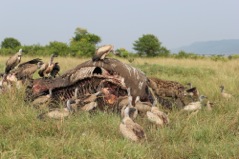
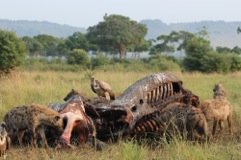
The charging hyenas go back the way they came, and the North clan starts moving forward again. This time, they move further forward; we emerge from the bushy thicket into an open area and see a mountain covered in vultures and hyenas that we don’t recognize. We quickly realize that we are seeing two clans, Oloololo and North, fighting over a relatively new elephant carcass.

IMG_0667-2013-06-22-15-22.JPG

North (right) approaching the elephant carcass surrounded by vultures and Oloololo hyenas

Initially the two clans appear to have nearly equal numbers. The Oloololo clan is in control of the carcass, and the North keeps trying to move forward to take the carcass, but Oloololos chase them back into the bushes at each attempt.

IMG_0725-2013-06-22-15-22.JPGIMG_0698-2013-06-22-15-22.JPG

North approaches and gets chased back into the bushes

Slowly, some of the Oloololos get their fill and start to wander off, decreasing their numbers. The North hyenas become more bold, getting closer to the carcass with each attempt before being chased off. Finally, they use their full force to chase off the remaining Oloololo hyenas and take control of the carcass.

IMG_0801-2013-06-22-15-22.JPG

North hyenas on the carcass with Oloololos off to the left

The North clan ate their fill that morning. Every time we returned to the carcass after that, the Oloololo hyenas had the carcass while some of the North clan was on the fringe. It seems that Oloololo won the war, but we saw an exciting battle along the way. It was also amazing to see the decay of the carcass over the next couple days.

IMG_0818-2013-06-22-15-22.JPGIMG_1000-2013-06-22-15-22.JPGIMG_1121-2013-06-22-15-22.JPG

Day1, day 2, day 3

Sometimes things can be really exciting here!

Wednesday, May 2, 2012

When life gives us rain...

...We look for animal tracks in the mud and make plaster casts! 
As a reference, the lion front paw is as big as a female hand with the fingers stretched out!

So Serena Camp is faring much better than Talek Camp. Our complaint of not being able to make it to 2 of 3 hyena dens seems very trivial compared to the midnight evacuations of Talek!!! Really, we can't complain, the rain has brought more carnivores to camp than usual! We have had lions come through camp during the night and early morning, including one big male whose roar literally made me fall out of bed. A hyena casually walked by the dinner table one evening and now hangs around the shower area at night. The usual herbivores still come around occasionally. We had 13 giraffes in camp one afternoon! THAT was noisy as they noticed us and ran away! I literally scared the crap out of one when I emerged from my tent brushing my teeth one morning. We have had many elephants, one of which has taken on the duty of forester/landscaper, trimming the trees along the driveway. 

I also recently discovered a new way to add a video since the original way most likely requires high-speed internet and foiled my plans. So expect many more! This one is of one of our South clan subadult females, Ranch, whooping. She received several whoops in response and shortly after, her mother, the infamous Clovis, showed up!

And this is one of North clan's cubs, Ratchet, the Master of Multitasking- scratching his/her back while grooming his/her belly!

An unexpected addition to this post: On Monday Noémie and I performed our first necropsy on a male from Happy Zebra, Loverboy (LBOY). We suspect he was killed by lions, although I will spare you the gruesome details. He was initially discovered in a torrential downpour at night, covered in tens of thousands of carnivorous army ants, so upon returning the next morning with Doom insect killer, we learned that army ants disappear during the daylight...but maggots persist regardless. Hyenas sometimes smell like dead animals when they're alive. A dead one was much worse. That smell did not wash off easily... or at all in fact. 
As a tribute to Loverboy, we will now present his life in pictures!

....Just kidding. 

I am also incapable of leaving a cheetah photo out of a blog post. So here is a video of the female cheetah who gave birth to a new litter in the first week of April! The video was taken March 29th, just days before she gave birth!


Friday, November 20, 2009

Where Have All The Wildebeest Gone?

The “Great Migration” has finally decided to move along from the Trans-Mara side of the Mara. Some of you may ask how it is possible to know when this is official, but let me just give you a couple photos to help exemplify my point.

Not more than 1 month ago, it looked like this everywhere:


There are still a few resident wildebeest that you can see around, but not nearly the all-encompassing groups that used to be a mainstay.

However with the wildebeest leaving, some of the other animals are coming back in larger numbers. You can imagine that with a few hundred thousand wildebeest, so come all of the flies and bugs that may get on the nerves of such temperamental animals such as elephants.


Another fun thing about the wildebeest leaving is that the zebras seem to stick around for the peace and quiet. It’s an interesting sight being able to see these black and white animals littering the landscape. Amazingly, it’s nearly impossible to take a bad picture of a zebra. All of my photos of these guys are going straight to National Geographic.


Monday, April 20, 2009

99.75%

Uganda. In a word, in a color: green.

Green like a wave, green like a storm. No calm seas, no lucid pools. A torrent of green, an assault.

Last night, in our private tree house, I wake up to, “Joey!” Not entirely unusual as that is my name. It was one of those yell-whispers where you start out with the intention of being quiet, but end up being louder than if you had just spoken.

“What?!” I yell-whisper back, trying desperately to actually whisper, “I am already awake!” for some reason her not noticing that I had awoken one second before she said my name bothers me at this hour. She doesn’t really need to explain herself as outside the masticating has reached a serious volume.

Our tree house in Kibale Forest, Uganda is about fifty or sixty feet off the ground. Gazeebo like in its simplicity there are two mattresses, two mosquito nets and a three hundred and sixty degree view. It is located perhaps three-quarters of a kilometer from the nearest building, the very expensive Primate Lodge, which is the sole building for several hundred square kilometers of forest.

“We request our visitors to retire to their tree house before 7:30,” the lodge tells us. Send those scum to their tree house! We have a good laugh at this until we do the twenty minute hike to our isolated moss-covered aerial platform. (No one to hear you scream). The sun is just coming down as we arrive and the forest comes alive. Cliché jungle noises abound. So cliché that you realize it’s not cliché, it never has been. It’s very much real. Vines wrap the surrounding canopy in a shaded haze. Monkeys call in the distance. To the west a large clearing filled with long long grass, the sun’s apical tip just visible through the opening’s granted horizon.

The air is a-hum with the insect life just out of sight. What sounds like cicadas. A cricket? It sounds enormous. A bat flies over catching up invisible aerial hexapoda. I wonder more at what we don’t hear than what we don’t see.

The equatorial sun sets in a flash of vibrant color so short it is hard to believe it is real. To paraphrase: you feel like you are losing your mind. In the fog of the tropical forest the air lights up like neon and the colors you thought you knew now throb and pulse with new life. Even the staunchest of scientists will stop and gawk.

Kibale Forest is located in south-western Uganda. It is 776 square kilometers, it has 13 primate species, 325 bird species, 144 butterfly species, and the annual rain fall is… more inane facts like these can be found on the internet. Suffice to say that this forest isn’t lacking in biodiversity. Most important park asset for a visit: wild chimpanzees.

Getting here was no small endeavor as traveling was done entirely by rooster infested matatu. I’m under the impression that the impending Easter weekend had a direct correlation to the mobile rooster population. However, perhaps Uganda always has high ration of roosters to people in its matatus. Despite the copious cocks it took about twenty hours all together to get from Shompole to Kibale. And that’s just the travel time. This doesn’t include mental stress induced by banana eating slobber monster children that insist on groping me while I try and sleep. This also doesn’t include days of down time in Kakamega, Kampala, and Fort Portal while en route.

Green hills of glossy tea leaves roll and roll. We pass the river Nile at around halfway. Non-descript trees with enormous fruits border the roadside. Wait a bit… that fruit is enormous. Like seriously enormous. What the f--?. I soon get a chance to allay my curiosity at the backpacker hostel.

The “Jack Fruit” is both the largest and heaviest fruit in the world. This is evident without anyone telling you it. No Magritte-esque tricks of perception needed here, this fruit is much bigger than your head. The fruit I pull off weighs maybe thirty pounds, it’s ovular, green, and has a strange checkered pattern on the skin. After separating it from its host the “stem” (the point at which I severed this alien cocoon’s life blood) begins to poor out milky white latex… all on its own. This is most unsettling. Contents under pressure. My preliminary examination ends here in disgust and lack of proper surgical instruments.

Wikipedia tells us that the jackfruit was cultivated in India six thousand years ago, I presume as some sort of catapult ammunition. The fruits can reach eighty pounds and three feet in length! Don’t believe me? Look! http://en.wikipedia.org/wiki/File:JackfruitLift.JPG

And for those wondering, it tastes sort of like pineapple when prepared right (or so they tell me).

Meanwhile it’s 3AM and the leaf-crunching is deafening. Luckily it is a full moon and the clearing, the “wallow,” is bright with silver light. An entire herd of forest elephants is foraging in zeal in eleven shades of white and gray. They make no sound as they move excepting the noise of their chewing. Incredible that such a large animal can move so silently and chomp so loud. As the moonlight glistens on my dumbfounded facial expression I realize, this is the closest I have ever been to an elephant. Awesome.

Being the excellent behaviorist and observer that I am I succeeded very well in failing to note any characteristics of the group besides the fact that they were elephants and were eating some sort of plant-like material. I can, however, relate to you some things about forest elephants. Immediate questions include: what makes the forest elephant different than the bush elephant? Why are they considered different?

Most people will tell you the forest elephant is smaller than the bush elephant. They would be right. What is also true is that the forest elephant has slightly more rounded ears, straighter and more downward pointing tusks, and five toenails instead of the usual four on the forefoot. As per usual the genetic evidence shows that the differences in these two species are greater than previously thought… or perhaps the difference is smaller than previously thought? The debate continues, but as far as I know the forest elephant is considered a separate species by most. Personally I was too busy staring to see anything.

The next day they begin the chimp walk with a few warnings: you might not see the chimps, we might have to walk three hours to find them, you might die, etc. I wasn’t really paying attention. Chimpanzees in the wild? Not something easily passed on. We found the group within an hour and a half. They pant-hooted from a half kilometer off and we zeroed in on their location. We examined broken branches, footprints, and other evidence of ape appearance. Just to be sure our guide radioed the guy that was with the chimps that day to find out exactly where they were (romance = gone).

One of the most aggravating things about studying monkeys in Costa Rica was when the monkeys found a fruiting fig tree. The figs fruit at random times and only for a few days. This means that when they find one they tend to camp on it for days. Chimpanzees are apparently no different.

Do not get hopes up. There is nothing more underwhelming than staring crane-necked at some apes which are barely discernible from the surrounding foliage. No Sistine Chapel moments of gazing longingly and finger touching with our closest genetic relatives at a three foot range. I would have loved to written here that I had some dawning moment, some epiphany, of the intelligence of these nearest and dearest. No such moments, only fig-chomping.

I left after my allotted one hour of viewing depressed and drained. I felt like I was sliding down the other side of my curve. What’s there to look forward to now? Mope, mope, mope, whine, etc. etc. I think it took a few hours to finally gain some perspective.

Stepping back I see my error. The active effect of time and memory is usually one of processing, filtering, and summary. I won’t remember being disappointed. No one bothers with a sore toe, a lost shoe. I will remember the sounds, the route, the euphoria of waking up and expecting the world.

Uganda at its most romantic: a glimpse of something special. The life, the green, the throb and pulse. Arms wide and fingers spread. The space between and the space without.

(I had a good vacation).

Thursday, January 8, 2009

Cute and cuddly

Many people do not think of elephants, rhinos and giraffes as cute and cuddly. Most people that know me are aware that I don't usually get too excited about things being cute and cuddly. In fact, I usually cheer for predator when they are chasing a baby gazelle. However, twice in the past few weeks I have been to the Elephant Orphanage in Nairobi, and there are some really cute animals their with some really sad stories. I have also visited the Giraffe Center was slipped the tongue by a 15 foot tall female giraffe.

At the Elephant Orphanage, they have about 10 young elephants, most them orphaned because their mothers were killed by poachers. They also a few rhinos, including one that was only a few days old on my first visit.

In the first picture, my friend Jesse Matter feeds one of the lovely ladies at the Giraffe Center. Jesse and his wife Cheryl, who recently completed her Ph.D. at UCLA, were visiting Kenya for two weeks. Unfortunately, the picture of Jesse kissing the giraffe were only on Cheryl's camera and not on mine. In the second picture is the baby rhino, with unknown kids used for scale. In the third picture, visiting Fish and Wildlife Ph.D. student Emily Johnston is pictured with the baby elephants parading by. The final picture is me with my "adopted" 3 year old blind rhino, named Maxwell. If you are ever in Nairobi make sure to visit the Elephant Orphanage and the Giraffe Center!


Jesse and giraffe


Baby rhino of infinite cuteness


Emily and the elephant parade


Andy and his adopted rhino

Monday, December 22, 2008

Those things can come out of nowhere ... Puzzle #2

For those of you that posted comments on the first picture in the series, there were three elephants in the first picture. There was a little one hiding in the bushes. In this group there were probably 8-10 elephants that were sneaking in and out of the bushes. I hope you can visualize a minute before I snapped this picture, when the huge elephant with the tusks was completely hidden in the bushes!

Here is the next picture.

Hint: Things are often hidden in the bushes, but sometimes things are hidden in Plainview.

Monday, December 15, 2008

I'm out

Well I've been writing for over five months now, and by blog standards I think that means I've earned a sabbatical. So I'm signing off until May or June, when I'll return in full force. Now now, dry your tears! It won't be that long, you will make it. Until then, I'm leaving you with a sampling of some of my favorite photos that I've taken here. Actually, all these photos are from last year, because I haven't had a chance to go through this year's batch yet. So those will have to wait until next year.


I'll catch you all on the flip side. Until then...
...do not disturb.

Michigan State University | College of Natural Science