Showing posts with label masai. Show all posts

Sunday, June 20, 2010

Snare Blues


Snares are one of the unfortunate consequences of studying a large carnivore in a park surrounded by a pastoral rural community. Some Masai feel that placing snares around their homes is a good way to protect their families and livelihoods against hyenas and other carnivores. Snares are also utilized by poachers and in some areas you are likely to see them on every animal you come across.

When hyenas find themselves caught in a snare, they are usually able to gnaw the cord holding them down but are unable to remove the loop that has tightened around their neck or leg. Sometimes they die from their injuries or suffocate if they get the snare caught on something later on. Other times, they manage to survive with whatever handicap the snare creates. Kay has told us stories about finding hyena remains with snares embedded in the bones. One of our immigrant males, Oakland, has a scar from a snare that is still in his neck. By the time he was darted the wound had grown over and the snare could not be removed without endangering his life. He seems to be doing just fine with it and has remained an active member of the Talek West Clan. Although, I am not sure if this is due to the snare or not, but Oakland has the strangest-sounding whoop I have ever heard.

When I got here I naively thought that snares were a thing of the past. The Mara Conservancy has been cracking down on poaching in the area and most Masai seem to understand that large carnivores are what bring tourists to the Mara. That fantasy world was destroyed about a week ago when we first saw Gelato, one of our Talek West subadults, with a snare stuck on her neck. At this point it seems very loose but she is unable to get it off. We've seen a few younger cubs and other subadults really attack the snare during play (like in the picture above) and we are getting a little worried that this play might tighten the snare further. For this reason, we have made darting Gelato a top priority so that we can remove the snare. Unfortunately Gelato has been spending all her time with large groups of hyenas and so far, no opportunities to dart her have arisen.

Please think happy thoughts for Gelato and we'll keep you posted on her condition.

Friday, June 26, 2009

Running back: a reentry

As I’ve mentioned in past entries, I often turn to jogging for all my therapeutic needs. Handily, it also accomplishes my exercise needs. So here’s an account of my thought progression during my first run back in the Mara:

Minute 1: So happy to be back on my feet on my old stomping grounds. Feeling light and energetic and ready to take on the world(!). (Sigh. This won’t last.)

Minute 6: The endorphins must be starting to kick in, because I’m having one of those isn’t-nature-so-amazing moments—a common feeling here in the Mara. I’m struck by the unparalleled blue and wide expanse of the Kenyan sky, the spectacular view of the hills rolling in the distance, and the serenity of the afternoon.

Minute 8: Moment over. Cue running, screaming, and waving children. At first I feel the warmth of familiarity, of a reunion with old friends…the same feeling I got when I saw Morpheus, my favorite hyena. But I’m quickly brought out of my genial haze as I get a swift elbow to the thigh. An overzealous kid is insisting on running six inches in front of me and is swinging his elbows like there’s no tomorrow. Well-intentioned, my young friend, but please excuse me as I gently shove you aside.

Minute 25: My mind wanders to random topics as I try to preoccupy myself during the long middle stretch…the Red Sox are 5 games up, that’s lovely (an ocean away, I still care)…Murphy should be having a new litter of cubs soon…I wonder what my most-loved one is up to right now...hopefully missing me….

Minute 33: I approach a group of older kids walking home from school. One by one, they fall into step with me, saying hello and then silently joining the trek. Now we are four, now nine, now fourteen. I smile, saving my biggest grin for the lone girl, knowing that she has faced many hardships to stay in school this long, and will surely face countless more if she is to finish secondary school against all odds.

Minute 36: “What is your name?” my companions want to know. “Leslie” is particularly difficult for Kenyans to say, and I am reminded of my journey to the Mara on a lorry from Nairobi a few days ago. While waiting for the driver to return from errands, a parking enforcement officer sidles up to my open window.

“You can’t park here.”
“Sorry, it’s not my lorry. You’ll have to talk to the driver. He’ll be back soon.”
“You have to pay a fine.” I wonder if this is because my white skin makes me look like an easy target for cash. Or maybe we’re just actually parked illegally. Probably both. I decide to use my charm as a young American woman to my advantage and offer an innocent smile and a Kiswahili apology. This seems to do the trick for the moment and we ease into small talk. He asks my name, and when I tell him, he makes me repeat it. He tries to write it down, and it takes him three tries of listening to me spell it for him before he gets it right.
“That’s too hard,” he says. “You need a Maasai name. I think it should be Naisenya.”
“Naisenya? That’s pretty, I like it. I think I’ll keep it.” He writes it down for me so I can get it right. He wanders off, having forgotten all about our parking ticket.

So I hesitate when the school children ask my name. I contemplate which is worse: giving my real name, which they’ll have trouble pronouncing, or giving my new Maasai name, and sounding completely crazy. I decide to go for it:

“Naisenya.” They dissolve into giggles—it’s a common Maasai name, but they can see I’m no Maasai. This disconnect pleases them to no end. I’m glad I went with that one.

Minute 48: Want to die. Cursed altitude, cursed equatorial heat, cursed unblinking sun, cursed Kenya! I’m too out of shape for this. What was I thinking, running this far my first time?!? That was an error. Maybe I shouldn’t have come running at all. Maybe I shouldn’t have come back to Kenya at all. Cursed heat.

Minute 59: The end is in sight, and with it, the endorphins are flowing freely again. I happily reach camp, reveling once more in my surroundings. My moments of self-pitying drama have passed and I decide that I am, without a doubt, happy to be back at Fisi Camp.

At least until the next time I try to run.

Monday, May 11, 2009

It ain't easy being Maasai

With my measly 5’5” height, my aversion to hot weather, and my personal dislike for red clothing, I knew I wasn’t born to be Maasai.

But hey, in the interest of cultural immersion, why not dip a toe into the local way of life? At Dupoto Forest, a gorgeous conservation area north of the Mara, we got some lessons on traditional Maasai activities.

And – as expected - it turns out I’m definitely not cut out to be Maasai. In fact, in everyone’s best interest, I should probably stay away from most of these activities. Bow-and-arrow shooting resulted in some humorous results. Needless to say, my arrows didn’t hit the target (or come even close). Luckily, I think my clever guides anticipated my ineptitude and gave me a particularly wide berth.


In an attempt to not burn down the largest intact forest in the Trans-Mara area, I left the next activity, fire-making, to the professionals. They have a very precise method: a smooth stick (made of wood from a fig tree) is inserted into a hole in a flat piece of wood (which must be African olive). After a mere minute of quick rotation, small shavings from the olive wood start smoking.


The shavings are dropped onto dry moss, and, with a few puffs of air, the moss catches aflame. Elegant, quick, simple (as long as you’re Maasai).


However, I am happy to say that I’m beginning to get the hang of one skill at which the Maasai excel: weather forecasting. Philomen can predict - to the nearest half-hour - if and when it will rain. Who needs weather.com when you have an expert around?

Anyway, in the midst of the rainy season, we’ve had a lucky streak of sunny weather. Yesterday, something just felt off, and I told Philomen it was going to rain. Lo and behold, my predicted downpour arrived, right on time.

I may not ever become a Maasai warrior, but if I pick up any of their amazing talents while I’m here, I’ll feel lucky.

Thursday, February 5, 2009

I should have been a cowboy

In my travels over the past several years I have found two of the best ways to really get to know a place to is travel on foot and to get your information from the locals, rather than a tourist destination. One goal of my research, and the Hyena Research Project in general, is to understand the local ecosystem as thoroughly as possible and answer questions associated with the ecology of the park. There is no substitute for first hand information, especially from people that have lived in the area their entire life. I would classify someone that can walk 20 kilometers in the dark, much of the time without a flashlight on, as someone that really knows the lay of the land. For this reason, I asked some of the local Maasai cow herders if I could accompany them herding cattle one night. I also thought it would be a sweet adventure, so this certainly was not a purely scientific expedition.

The night of February 4th, a local herder stopped by to meet me and we walked to join his fellow cowboys. The herders said the herd we were tending that night was 500 cows, but I would estimate it was closer to 250. We had seven real Maasai herders and one mzungu (white guy) wannabe herder for the job. Four other Maasai acquaintances of mine actually showed up to see if I was actually going to go through with my plan. They said hello, laughed a bit at my unusual attire (sunglasses, backpack, no jacket, lack of a spear, etc...) then headed back to their manyatta.

The cattle herd


Three of the seven cowboys for the night (there is eight if you count me, but I was quite useless except for having several flashlights)


For the past two weeks it has rained nearly everyday and I expected this night would be no exception. Soon after we began, it was clear we were in for rain. The worst of the rain was to the West and to the Southeast, but we got out share. By 7:05 we had our first bullfight of the night. Two of the dominant bulls in the herd locked horns and set the tone for the night. A young cowboy told me the black bull was his father's and the white bull was another manyatta. We crowded around to watch the fights with much excitement. It looked to me like Andrew's bull was getting the best of Fred's, but Fred insisted his bull was the bravest. This was later verified, as this large bull continued to throw his weight around the entire night. At one point nearly driving another bull to the ground.

My inexperience in cattle herding in the Mara first became apparent when I stuck my herding stick down into a termite mound. I have heard many stories of people eating termites and I was thinking of having a snack. I let go of the stick and it dropped nearly one meter into the hole! I thought I had lost my herding stick for a second. A few laughs from the crew and we were moving again.


Bullfight #1 between two heavyweights


Rain looming on the horizon


Around 9pm, we had our first talk of lions in the area. As a rookie in the cattle herding game, I would not have noticed, but Fred told me that when the cattle stop grazing and sniff the ground or the air, they have probably caught the scent of a lion. In this case, a group of cattle was sniffing the ground, so the herders went to inspect. The grass was matted down and they managed to find a hair they said was from a lion. The cattle remained wary and at one point there was commotion on the right side of the herd. Most of the herders took off running towards the commotion thinking a lion may be attacking, but it turned out to be another battle of the bulls. Crisis averted. The cows continued to pick up the scent of lions and I was told at one point there were probably lions in the bushes nearby, but they never materialized.

At 11:30pm, the cattle were showing signs of fatigue, so it was time to rest. We rested in the wet grass for a little over an hour. Most of the cattle did the same. It was getting cold by this point, so some of the herders used each other to conserve body heat. Around 12:30am we were moving again the sky broke open again and soaked anything that may have dried in the previous two hours. My shoes were soaked and it felt like there was a tack stuck in my toe, but most of the guys were expecting me to not make it through the night, so I kept this to myself and trudged on, still in good spirits. I had realized early in the night that it felt warmer when I was near a large part of the herd. The body heat generated by these large mammals pushed a wave of warm air in front of them, followed closely by a smell common to any barn or ranch I have been to in the states.


Earlier in the evening, between the thunderstorms, the moon had illuminated the landscape. The latest rains had blotted the moon out of the sky and its almost totally dark and I was at times clueless as to our location. Some of these guys had been herding cattle since they were 4 years old, so they could have found there way with their eyes closed. On a couple of occasions I did actually see them walking slowly with their eyes closed. We found one guy sleeping standing up. He was totally out, but still standing straight up, which amazed me. One of the herders was about 10 years old and he was given the most difficult duty of bringing up the rear and chasing the stray cows back into the group. I stayed with one of the senior guys while he walked ahead to look for lions, buffalo, elephants or whatever might be lurking in the darkness. After verifying there was no danger, he would often lay down for a little snooze. I refrained from napping because I had heard that cowboys occasionally get left behind when the herd moves on while they are asleep. My eyes were closed a couple times, but I would debate whether it was sleep or not.

Cowboys dozing in the wet grass with their spears and cattle nearby


By 4am, the cattle were apparently full. Many of them were just walking or standing and not grazing, which apparently means they have eaten their fill. I was happy to hear this, since this meant we would be moving towards home at a faster pace. My foot was throbbing and there was not a dry spot on my body, so the thought of a warm bed was attractive. We had walked about 13 kilometers by this point, but we had about 4 more kilometers to walk yet, and most of the distance had become one large puddle during the night.

We slipped and slid towards the manyattas where the cattle and herders lived and warm chai and fresh milk straight from the cow awaited, but when we got close, the cell phones began ringing and news came that the Talek River was too high to cross. Three of the herders then split with the group and walked me back to camp. The others waited at the river's edge for the water to subside. Back in camp, the group settled in for warm chai. The first drink most of the herders had had since leaving their manyattas more that 12 hours and 17 kilometers ago. Not only do they not bring water for the night, they don't bring food. After carrying my backpack the entire night and having my shoulders ache, I have decided that not carrying food or water may be a good idea. Around 7am the herders headed back to the cattle and I headed to bed. After plucking a few ticks from myself and tearing at several siafu (biting ants) out of my legs and arms, I was ready for sleep after being awake for more than 24 straight hours.

Tuesday, December 9, 2008

The Universal Language

***This post is dedicated to the members of Team Arts Bar (no apostrophe), old and new. Beat Team Baby Tee! See you January 2…

Don’t listen to anyone who tells you that love is the universal language. There is only one International Language, and I will tell you what it is: football. Okay, soccer if you want (let’s take a moment to appreciate the irony that there are multiple English names for The International Language). Soccer transcends all languages: a goal is a goal in any tongue, and a well-executed slide tackle needs no words at all.

I have spoken The Language for almost twenty-one years now, and during that time I’ve played with my share of various nationalities. I’ve played with Mexicans, Brazilians, Englishmen, and now Kenyans. I can feel so out of place in a country and struggle to communicate with locals, but when I see people playing soccer, my worries vanish instantly. It is a great feeling to approach a group of people I don’t know and with whom I can’t converse, grinning like an idiot, and gesture that I want to play with them. I’ve never been turned down—it is the people’s sport, and all are welcome; that’s an unspoken rule of footballers everywhere. The playing commences and the Talking begins…passing, dribbling, juggling, and shooting.

The other day I ran into downtown Talek only to find that there was going to be a match. Each of the lodges in our area has its own team, and throughout the summer and fall they have an enormous round-robin tournament. The games draw quite a crowd and the ultimate winner maintains bragging rights until the following summer.

So I get to the field and I see one team sitting in a circle behind one goal, the other team nowhere to be found. “What kind of a warm-up is THIS?!?” I ask them with a smile. They inform me that the other team is running late because their car has broken down (this surprises no one). I point out that we can still PLAY, so a few guys get up and we start juggling in a circle. Then they get a call that the other team has fixed their car, hooray, and we start upping the ante a little (not to mention our heart rates), playing keep-away. I marvel at the fact that none of them seems the least bit perturbed that I have joined their pre-game warm-up, despite the fact that obviously I can’t play in the game—these games are official, with rosters and uniforms and referees and the whole bit. Only one or two of the guys in our circle speaks any English, but as I’ve said, this doesn’t matter at all. Keep-away doesn’t change much, even when you cross oceans.

Then one of them gets a call that, oh dear, the other team isn’t coming after all. So the guys start organizing an intrasquad scrimmage, and much to my delight, I am going to be included. But just as we start to make teams, two land cruisers come racing up in a cloud of dust and guys start pouring out of them like clowns out of a Volkswagen, pulling on cleats and uniforms as they run toward the field. Disappointing for me, but good for the home team. The game starts over an hour late, which really isn’t all that bad considering the attitudes toward punctuality in our area (“Oh, I’m late? Must be God’s will.”).

As the game begins, more people start wandering over from the nearby downtown area to watch. Some cheer, some clap, some just stand idly and chat with their friends. I get far too wrapped up in the game and whoop and holler with the best of them, jeering the referee at poor calls and groaning at missed opportunities in front of the net. When the visiting team is offsides I flail my arms and shout, although I don’t think anyone has any idea what I’m talking about and I get more than a few odd looks from Maasai (“Oh look, Crazy White Girl is here and has completely lost her mind and control of her faculties. How charming!”).

But my favorite part of all is halftime. In international-level play like the World Cup, not to mention in the States at any level, it’s typical for the team to go off and have a private meeting with its coach during halftime while getting some water and regrouping. Not so in Kenya. Here, the team goes and sits with the coach, but then—here’s the kicker (har har)—the ENTIRE fanbase moseys on over and joins them. We’re talking well over a hundred people who invite themselves to hover within inches of the sweating players, listening to what the coach is saying. And it gets better. After the coach is done giving his spiel in a mixture of Swahili and English—and, frankly, sometimes before—random people start chiming in their two cents about the game thus far. Fans, friends, miscellaneous goats, all are welcome to contribute their ideas about what could be done better. And the players actually listen, too, which is to their credit, because I know what I would have said if some random person came up to me at halftime, after I’d just run my butt off for 45 minutes, and began pontificating about how I should do this and that, but I don’t think I’m allowed to write it here. Instead, these men are polite and open-minded and even ask me MY opinion, which catches me so off-guard that I blush, smile, and shake my head. (Then, regretting that instantly, I pull the captain aside and inform him that no, you DON’T want your tallest and strongest guy taking the corner kicks, you want him IN FRONT OF THE NET. Duh.)

The men share two 1-liter bottles of water among them—not nearly enough in the equatorial heat, but they don’t need mothers—and then take the field. There is a short delay as a stray cow is herded off the field, but no one seems to mind. Soon the men are running back and forth once more, and when the home team scores the winning goal, I hoot and clap along with everyone else.

As I start walking back towards home, I pass a kid of about ten who is kicking a ball around on the sideline. I wave and he says something in Maa, and I just shake my head and shrug. He kicks the ball to me and I look up, grinning. Now those are Words I can understand.

Thursday, November 20, 2008

Kila Nafasi


“When you educate a boy you are educating an individual. When you educate a girl you are educating a nation.” —Ibu Badir

As I wrote last time, the Maasai have not historically made education a high priority in their communities. Given the traditional roles of women as mothers and homemakers and men as cattle herders, this is understandable. Unfortunately for the Maasai, the widespread lack of formal education among their people has put them at a great disadvantage economically and politically with respect to the other tribes. It’s difficult to get strong representation in government without being highly educated, and with the growing spread of capitalism and technology, other tribes have taken advantage of education to make economic progress far beyond the Maasai.

Although Kenyan law decrees that all children must attend primary school, the rural nature of Maasai communities makes enforcement impractical. Many children still do not attend school, or attend for only a few years. Compounding the problem is the fact that school is not free in Kenya as it is in the United States, and in order to attend primary school you must be able to afford the fees.

But these fees pale in comparison to the fees one must pay to attend secondary school (equivalent to our high school), which is not required by the government. Eighth graders in their last year of primary school take a nationwide placement exam that determines which secondary schools they are eligible to attend. The students that perform the highest on the exam are then welcome to attend the very best secondary schools in the country…if they can afford it. Because all secondary students board at their schools, a secondary education costs approximately $450 USD per year. It is therefore easy to see how some families might view education as a cost they simply cannot afford.

This problem hits girls much harder than boys. Although some Maasai families are beginning to recognize the importance of sending their sons to school, most are still very reluctant to pay such high fees for their daughters. Female enrollment in primary school really tapers off in the later years of primary school: in the local Talek Primary School, there are only six girls in Grade 7, and only two girls who have made it to Grade 8. This is undoubtedly in part due to the fact that the girls know they have little hope of continuing onto secondary school, so there isn’t much incentive to finish primary school.

This trend has implications far greater than whether or not a girl can recite her multiples of eight or name all the planets in the solar system. Girls who attend secondary school are more likely to get a paying job, less likely to contract HIV, and more likely to then educate their own children. Girls who do not attend secondary school are more likely to be circumcised and married off at young ages of twelve and thirteen. “Female circumcision,” which is really just a euphemism for female genital mutilation, is illegal in Kenya, but is still practiced in rural areas. Beyond being cruel and unnecessary, it put girls at great risk for infection and makes childbirth very difficult. I have even heard horrifying stories of young women starving themselves during their pregnancies so as to have as small a baby as possible, because the nature of female circumcision makes a woman’s body prone to tearing and excessive blood loss during childbirth. Needless to say, undernourished pregnant mothers produce undernourished babies, many of whom then have developmental problems.

Okay, now that I’ve made you thoroughly depressed, I’m going to change the story a little bit.

Enter John. Enter Katy. Enter Audrey.

John (the same John from my last post) is an especially progressive Maasai man—one who values education for all, especially women, and decries female circumcision as outdated and inhumane. For years now, John has taken his own time and money and traveled around to rural Maasai communities, leading workshops for women on HIV prevention, the importance of education, and the dangers of circumcision. He has also used personal finances to fund the secondary education of girls who have shown academic promise but whose families could not afford school.

Upon hearing this in 2006, Katy, another student in the Holekamp lab, teamed up with the Infamous Audrey to help expand John’s efforts and educate more Maasai girls. The result was Kila Nafasi (“every opportunity” in Swahili), a non-profit organization based in the United States. Kila Nafasi’s sole purpose is to provide scholarships to girls who are academically qualified to attend secondary school but cannot afford it. I joined Kila Nafasi in 2007, and I am proud to say that as of 2009 we will be sponsoring nineteen girls (see photos), including several from the Talek area. We send the money from our generous sponsors (all tax deductible, of course!) directly to the schools, and we visit the sponsored students periodically throughout the year to ensure that they are receiving the education our sponsors are paying for.


Public consciousness of some struggles African women face—HIV/AIDS, genocide, female genital mutilation, poor health care—has increased dramatically in the past several years. Education plays an important role in the solutions to these problems (and countless more), and Kila Nafasi is proud to join the fight. As our organization grows and more students are sponsored, a secondary school education is becoming a realistic dream for primary school-aged girls in our area. Unfortunately, this means that the need for scholarships currently exceeds the available funding. If you’d like to help in any way, either by becoming a sponsor or making a one-time donation, please visit our website, where you can also learn more and see more photos of some of our students. For more information on the benefits of educating girls in underdeveloped nations, read Jonathan Alter's September 20, 2008 article from Newsweek.

I will close with this:
All of our sponsored students are remarkable, but the ones that really blow me away are the ones who had to defy their parents’ wishes to attend school. Imagine being fourteen years old and looking your mother and father in the eye and saying, “I know you want a certain life for me, but I am choosing a different path for myself.” What strength and courage these girls must have! After all, they know that their choices might very well make them shunned from their families and considered unwelcome in their own homes. John has been kind enough to open his home to some of these girls during school holidays, when they have nowhere else to go. Others stay in a church, surviving only on the generosity of their neighbors. These brave young women have had to fight so hard for an education many of us take for granted, and yet they keep fighting, keep struggling, keep sacrificing. Would we all were that strong.

Tuesday, November 11, 2008

What it means to be a Maasai

I’ve wanted to write a post for a long time about the culture of the Maasai, the ethnic group that lives in our area of Kenya. I’ve hesitated for fear of being unwittingly politically incorrect, but that seems like a silly reason to deprive readers the opportunity to increase their worldviews. I figured the best approach would be to talk to a Maasai and get the story straight from the horse’s mouth. So I spoke with John (pictured below), a Maasai man who has worked at Fisi Camp for over a decade, and asked him to describe his people as completely and objectively as possible, and he did a great job. So if anyone is uncomfortable with my general depiction or specific word choice (ex, use of “tribe”), please understand that the information is all from a Maasai person himself, and he approved this post before I published it.

The Maasai people are nomadic pastoralists, which accounts for their generally tall and thin body types. According to legend, the first Maasai came from the sky with a cow, so Maasais believe that all cows everywhere (yes, even the ones in Vermont) really belong to them. They therefore have a very strong attachment to these cows: as John put it, “A Maasai without a cow is not a Maasai.” In fact, cows are the standard of currency among Maasai: one average-sized cow is equivalent to about 10,000 Kenyan shillings or about $150 USD.

The traditional roles of men and women are pretty, well, traditional. Men are the heads of families and the community leaders, and are in charge of the cows and providing security for the family. Women (“mamas”) care for the children and the house, collect firewood and water, do all the cooking and washing, buy food at the market, and build all the huts out of dried cow manure (it can take two women about six months to build one home). Boys often herd cows, but girls have many more responsibilities, as they are expected to help their mothers pretty much as soon as they are physically able to (it’s not uncommon to see a child as young as four or five caring for a younger sibling).

Historically, education has not been a priority for the Maasai. There is much more to be said on this topic, so I’m going to save it for my next post, so stay tuned for that. For now, suffice it to say that the Maasai have traditionally been unenthusiastic about educating their boys, and extremely reluctant to educate their girls. Instead, girls are circumcised at the young ages of 10-13 years old (more on this next time, too). Once they have been circumcised, they can then be married off to men of between 16-40 years old. The bride is not given a choice in whom she marries, and the bride’s family typically receives between five and ten cows as payment. Mamas then begin bearing children at around age 15. Multiple wives are seen as a sign of affluence, although as more and more Maasai become Christian, this custom is becoming less common.

Maasai men are typically grouped in “age sets,” which are cohorts consisting of men who are all within several years of each other. A person’s cohort is a big part of his identity, and each cohort has its own songs and dances that are used in celebrations. The time-honored custom has been that when boys are between 16-20 years old, thousands of them will be circumcised together as one cohort. This cohort will then live together and train to become Maasai warriors, and those who are able to kill a lion single-handedly become the most superior warriors. Warriors are then responsible for protecting the tribe from other marauding tribes. However, in recent decades, since the Maasai’s inter-tribe conflicts have subsided almost entirely, the need for warriors is diminished. That fact, combined with the government’s credo that “all children must attend school” (a law that is not enforced in rural areas), has made Maasai warriors slightly obsolete and much less common.
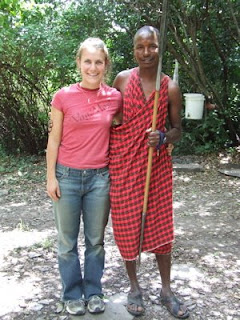
The spoken language of the Maasai is Maa, and although John, who speaks four languages fluently, happily claims that it is “not hard,” I can attest that for native English speakers, it is extremely difficult, because many of the phonemes are so different that we physically can’t form them with our mouths. (Swahili is much easier, because it’s based on the same alphabet and phonemics as English.)

The predominant foods are milk (cow’s) and meat (cow and goat), and chai tea is both a nutritional and social staple. Fresh cow’s blood is also a popular traditional drink, especially for women who have just given birth so that they might replace the blood they have lost. Fruits and vegetables have really only entered the menu in a substantial way in the past decade as imports and transportation to rural areas have increased.

Maasai mamas usually wear wrapped skirts and cloths, and both men and women wear “shukas,” which are all-purpose shawls that can protect against the sun and the cold. Interestingly, Maasai in different areas have different colors that dominate their wardrobes. In our area, the major color is red with hints of yellow, but the Maasai in Tanzania wear predominately blue with hints of white. The Maasai are also famous for their beaded jewelry, which comes in all colors and can be quite elaborate. The mamas are very skilled and make all of the jewelry by hand. Some of it has special significance: for example, the large circular necklaces are bridal necklaces, and men who have lost their father will wear a metal bracelet on their right arm to honor him. On special occasions, Maasai will wear their most formal garments and adorn themselves with dozens of pieces of this beautiful jewelry.

As I’ve hinted throughout this post, these times, they are a-changin’. Since the Kenyan government privatized most of the grazing land, the Maasai have become significantly less nomadic and have formed more permanent communities. Some are branching out and have started to cultivate crops such as wheat and maize (not in Talek, our local Maasai community, but in other parts of Kenya). Likewise, as more Maasai get educated, more are opening small businesses and shops. Additionally, the increase in education has started to reverse what has historically been a lack of involvement and interest in politics. It’s also getting more common to see Maasai wearing western clothing.

I asked John what, above all, he wanted to communicate to Americans about the Maasai people. He said that they are very brave, very proud, and very honest. He said they are not as prone to theft as other tribes, and have excellent manners. They are also extremely friendly, and welcome members of other tribes who come to live among the Maasai.

I couldn’t have said it better myself.

Sunday, October 19, 2008

Maasai Medicine

Doctor “Action” Jackson (shown below, with the BEAM 2008 class) runs the local medical clinic in Talek, and has been a good friend to the residents of FisiCamp for many years (it’s nice to be on good terms with a doctor when you work with bone-crushing predators). While the basic principles are the same, third-world medicine is a world away from the health care system with which we are so familiar.


The clinic consists of a waiting area, two tiny examining rooms, and a storage room that doubles as a treatment area (shown below). With no access to the expensive hospital equipment on which American hospitals rely, Jackson’s shelves are stocked instead with cotton balls, alcohol swabs, and painkillers. However, his knowledge of medicine is impressive and he relies on common sense and resourcefulness rather than high-tech treatments. He has even fashioned a simple, solar-powered centrifuge from a Tupperware container and a tiny electric motor.


Jackson sees dozens, and sometimes hundreds, of patients each day. On the busiest days, there’s a line way out the door of the clinic, and patients must wait for hours to be examined. In order to make medical care widely available, he keeps his rates very low; adults pay 300-400 shillings (about five dollars), and children are usually charged just 100 shillings (less than two dollars). If a family can’t afford treatment, he often pays out of his own pocket. Livestock is the major form of currency among the Maasai, so Jackson sells cattle in order to fund his work and keep the clinic running. Here's two Maasai "mamas" waiting to be seen by Jackson.


According to Jackson, malaria and pneumonia are the top two causes of death of Talek residents. However, Jackson also has lots of experience with conditions that are less familiar to us Westerners. Obviously, life in the bush can be dangerous, and Jackson treats more than a few animal attack victims per month. Lion and buffalo are the biggest problem animals; however, a few days ago when I dropped by to see Jackson, he was treating a man who had just been mauled by a leopard. Deep, bloody gashes covered the man’s arms, hands, and head. What amazed me most, however, was that the man was walking, talking, and able to return home the very next day.

While his knowledge, generosity, and passion have been embraced by most locals, Jackson has also made some controversial moves. By speaking out against female circumcision, as well as against some cultural beliefs regarding HIV and other STDs, he has made some enemies who condemn his disregard for valued Maasai customs. Despite these adversaries, however, Jackson continues to provide low-cost, innovative care to the residents of Talek.

Wednesday, September 17, 2008

Running in Kenya does not a Kenyan runner make

At an altitude of almost 3,000 ft and under the equatorial sun, I'm not exactly churning out record-breaking times when I go running here. Running in the Mara is, needless to say, quite different from running in the States. Technically, I don’t run inside the Mara, I run just outside the border, through the Maasai community that neighbors our camp.
The landscape is a far cry from my typical suburban route—rolling hills of savannah, dotted with acacia trees and wildebeest, spread out to the south. To the east and north are mountains, and to the west are manyattas (Maasai homes—see photos), which are mostly made of dried cow manure. The view allows me to see rain coming from miles away, as opposed to at home, where dense trees and buildings make any jog a guessing game weather-wise. The river that forms the border of the park separates me from any carnivores, buffalo, or elephants that might present a threat (or at least that’s what I tell myself, although I haven’t seen anything more than a gazelle so far).

After I cross the river from camp, I make my way through a few bushes and out into open fields, all of which have been grazed down to mostly dirt by the Maasai’s livestock. I follow a cow path onto the road and turn west, making my way up the hill into the Maasai community, all the while avoiding piles of poop and mud puddles. Sometimes cars with tourists will pass me, and I love seeing the confused look on their faces at seeing this random white girl running in the middle of a Maasai community.

As I approach the first cluster of manyatas, I’m usually spotted by a child or two, who shriek to their friends that I’m arriving. Within seconds, kids pop out from every corner and gather at the road ahead, grinning and waving and shouting things in Maa (the Maasai language) that I cannot understand, but presume to be something along the lines of, “Crazy, crazy white lady, why are you in such a hurry?” Usually the kids will join me for a few hundred yards, running by my side, peppering me with questions that I can’t answer. Sometimes the crowd gets so thick—yesterday I had about twenty kids and two dogs with me—that the kids trip over each other and fall. Despite my rudimentary Swahili warnings of “pole, pole!” (“slowly, slowly!”), this inevitably cracks them up and they waste no time in catching up to the group. The kids range in ages from two to about fifteen, both boys and girls. They laugh hysterically as they weave in and out of my path, and love high-fiving me.
Most of the time, the children will run with me for a few minutes and then stop before they stray too far from home. Occasionally, though, I’ll acquire boys walking home from school. These boys are typically on the older side—between nine and fourteen, I’m guessing—and will often run with me for a mile or two. Given that they are wearing sweaters and carrying backpacks, this never fails to impress me. I have to admit: although I enjoy the attention of the younger children, it can be exhausting trying to make sure I don’t run anyone over (harder than it sounds), so I much prefer the older kids. They’ll stop walking when they see me, and as I reach them, they’ll casually say hello and fall into step right next to me, matching me stride for stride. They will run silently next to me until we pass their manyattas, at which point they will wave goodbye and abruptly veer off. I find these kids very comforting, because instead of being my spectators, they are my companions—they’re not in it for me, they’re in it for the run. When they leave, I shout, “Very good! Goodbye friend!” after them, and they grin as we go our separate ways.

Michigan State University | College of Natural Science