Monday, August 15, 2016

Living double lives


While it is often joked that getting a PhD can be stressful and quite time consuming, for those who choose to utilize field data, it can be doubly so. Graduate students rarely have the time to do much data analysis, or writing, while they collect their data in the field (the same goes for grad students that are teaching). For example: on the hyena project we spend at least six hours a day collecting field data, and then another few hours getting it recorded in legible format, seven days a week. We also have chores to do, and need a bit of sleep and time to relax to be fresh for the next day. So for all of the grad students on this project, this means that they have to double down on their research lives, and plan for time in some form of a lab back home. This could be in a computer lab, where they will develop analytical techniques for understanding audio, video and transcribed behavior, or in a wet lab, where they will be analyzing biological samples like blood, feces or saliva, or in many cases students will use both computer lab and wet lab data. Only then they will finally get to sit down to actually analyze the data, and write it up. While this seems like a tall order, we all still chose these projects through our love of science and discovery. As an example of what this looks like, I will use a current project I am working on alongside a few of my colleagues.

We are interested in a subject called behavioral epigenetics. “What is epigenetics?" you ask, well at the root it means above (epi) genes, in that something above your basic genetic code is having a observable effect on what is physically presented by an organism. You see your genetic code, or DNA, is not the end all of making you what you are (ie your phenotype). A great deal of your physical appearance and behavior, depends on how and when your genes are expressed, and the process of expressing a gene can be modified. What is interesting is that these modifications can be affected by the behavior of individuals around you, and in turn modify how you interact with others.

A possible example
Pene and Ziti [seen to the left with their mom Guci] lost their mom when they were still quite young.
They were still fairly dependent on mom for access to food, defense from other hyenas, and to learn their rank.
Subsequently, these two are somewhat odd compared to most natal males, in that they still have not dispersed,
which usually happens between 2 - 3 years of age, and Ziti [above right] is over five years old now!!!
This variation in behavior may be due to their experiences after loosing their mother,
which could have altered their behavior through epigenetic modifications.
To help explain what I am talking about, I will give a quick explanation of what I mean when I say gene expression. A gene must be transcribed in the cell nucleus, which requires a cluster of proteins called a transcription factor to bind to DNA upstream of the gene that is going to be transcribed. This happens in areas of the DNA called promoter sites. Then the transcription proteins unzip the DNA and make single stranded copies of the gene called RNA. RNA is different than DNA in that it is both single stranded, where DNA is two strands fused together, and during transcription one of the nucleotides that make up the genetic code of DNA (for biology class recall these are “A”, “T”, “C” and “G”) are replaced with a different RNA nucleotide (“T” gets replaced with a “U”). After this the new RNA must be processed, where it basically gets trimmed of regions in the original RNA code that don’t match up with the protein that the RNA was transcribed for. This trimmed mRNA (messenger RNA) must be moved out of the cell nucleus and into the open cell space of cytoplasm, where proteins called ribosomes, along with other specialized pieces of RNA, translate and create the final protein to be used by the body.

© 2010 Nature Education All rights reserved

Of course this is a very simplified explanation of gene expression, but it does point out the basic steps, and each of these steps can be varied based on what is going on in and around the organism. Much of this happens very very fast, and variation can be very small with big consequences, making it nearly impossible to study. What my colleagues and I are interested in are permanent to semi-permanent changes to the gene expressions process, that occur during physical development, which is what is commonly termed as epigenetics. One of the most well understood epigenetic changes comes in the form of an alteration in the very initial step of gene expression, when the transcription factors I mentioned first attempt to bind to the DNA upstream of the gene in the promoter region. A simple molecule called a methyl group (a carbon atom connected to three hydrogen atoms) can also bind to nucleotides in these promoter regions, interfering with the transcription factor protein's ability to land and start the transcription process.

Methylation basically interferes with the transcription factor's ability to bind to the promoter,
thereby reducing the efficiency of gene transcription when the gene needs to be transcribed by the body
Here is where things get really interesting. Scientific research has shown that how an organism interacts with its environment while it develops, can affect how many methyl molecules are bound to different promoters for different genes (this is termed methylation). What is really cool, is that it has also been shown that the behavioral environment an individual is raised in, such as variation in maternal care and social interactions with peers, can have large effects of the level of methylation different genes have. In short how you are raised can affect how your genes are expressed as you develop, which can alter your physical appearance and behavior for life!!!

Really cool right?!?! However, in getting back to PhD students leading multiple lives, this means that my colleagues and I must have behavioral data from when hyenas are young, as well as when they are adults, including detailed data about how moms vary their time and care among cubs. We also need to utilize biological samples for us to study RNA levels and DNA methylation, which requires a lot of effort in the lab as the technology utilized to study epigenetic changes is still relatively new, so there is some trial and error work to get done. Finally, we have to develop analytical techniques to combine the behavioral data with the genetic data, while keeping in mind that basic environmental factors, like game availability or rainfall during the year, can have major effects on development and possibly alter epigenetic modifications. 

Needless to say, this is a lot of work before we will even get to the analyses and write up, and nearly all of our colleagues are in the same boat when trying to juggle their field data with their lab data. Granted we chose this, but if you ever see a grad student wandering around aimlessly, or staring off into space, please remember they may be leading double lives.

Special thanks to:
PhD Comics: http://phdcomics.com/comics.php
Scitable of Nature Education: http://www.nature.com/scitable

Monday, August 8, 2016

Mail from a male

Dear humans,

My name is Juba, and I am an immigrant male spotted hyena in Talek West clan.  Like all immigrant males in the Mara, I was named after a city: in my case, the capital of South Sudan.  I'm also currently the only Talek West hyena sporting a super-cool accessory: an old green ear tag, broken off in my left ear.  I prefer to think of it as an earring, thank you very much.  A really fancy earring.

This is me.  Check out my bling!
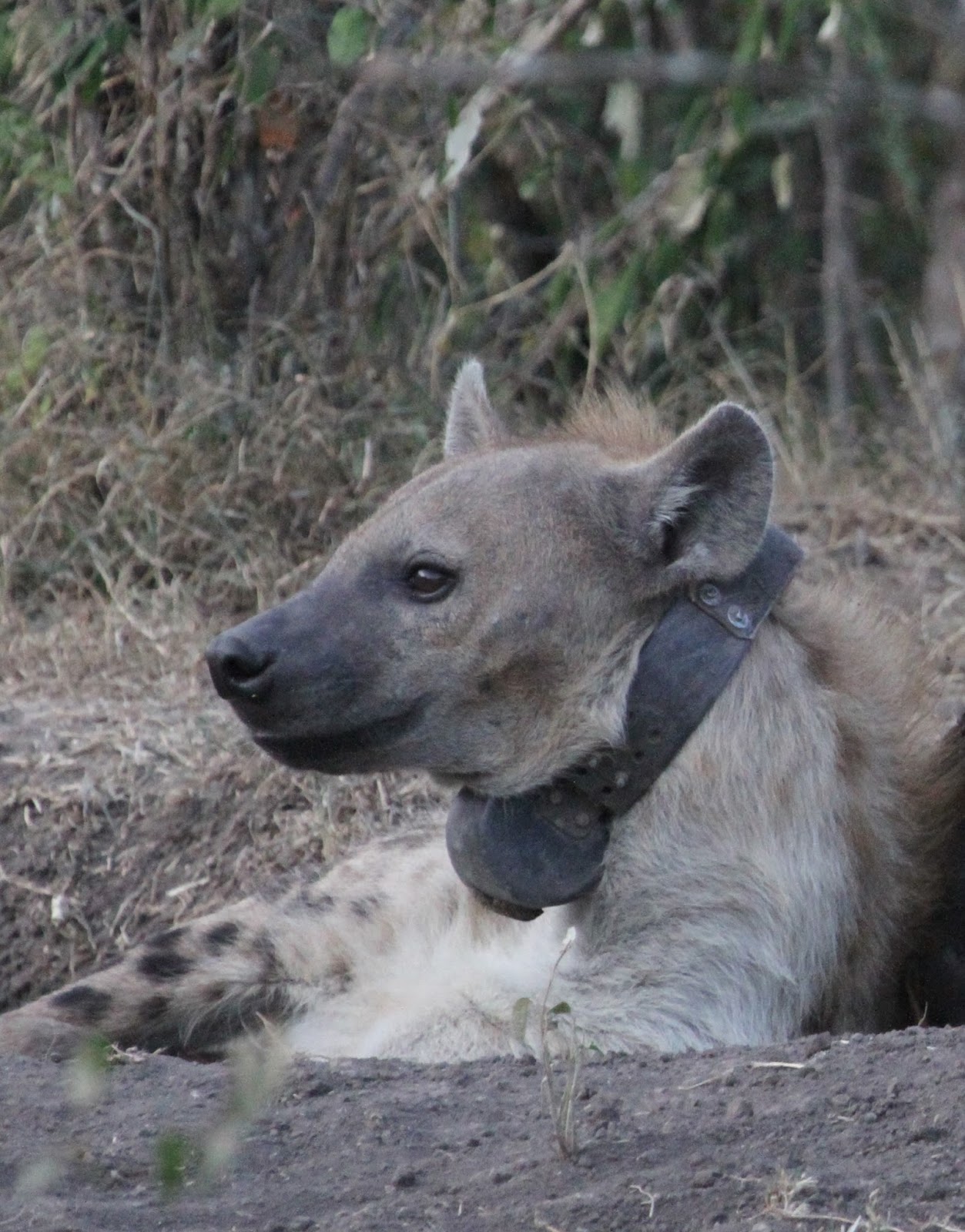
Anyway, I am writing to you with a simple request.  Lately, I've been following my lady love, a beautiful female named Helios, around the Mara.  She was named after a Greek god of the sun, and my, does she look it!  Check her out.

This is my girl.
Helios and I have been going on a few dates.  You know, wander sniffing, lying around in the bushes, stuff like that.  She was born in 2006 and has had many offspring, and I'm a little on the older side myself, so this is not our first rodeo.  We've just been spending some time together again, taking it slow.  But lately, our privacy keeps getting interrupted by this car.

Have you seen this car?
Everywhere we go, they find us.  I wonder if it's that thing Helios has around her neck.  Humans put it there, and while it's kind of a fabulous necklace, I think it might be leading them to us.  We're just an older couple, trying to spend some quiet time together, but just when we start to doze off, sheltering from the sun in a nice clump of bushes, they come up to us in that car and startle us out of our daydreams.  What's more, the last time it came, the car made a beeping noise at us: kind of like that sound wildebeests make, but sharper and more annoying.  They weren't really threatening us or scaring us, but it was still a little irritating.

So, humans, if you happen to know the people who drive that car, can you express my vexation to them?  Tell them this: I'm trying to court my lady here!  Can you be a bit quieter next time?

With all due respect for the super-cool hyena jewelry you make (but slightly bothered by the car thing),

Juba

****
Dear Juba,

Sorry about startling you!  I didn't mean to honk the horn of the car.  I was re-adjusting, balancing a bunch of equipment in my lap, and I hit the horn by accident.

We did not intend to disturb you or to interrupt your date.  We track our collared hyenas (like Helios) to find them and see what they're doing, and to gain new information about hyena movement patterns.  The data we collect is very important, because it helps our fellow humans to understand your kind better and hopefully to care about them more, so we can all work together to protect you and Helios and other animals in the Mara.  We try to be as quiet and as non-invasive as possible when we drive up to hyenas, but since you were hidden in the bushes, we didn't even see that we were driving so close to you until it was too late.  I feel really badly for startling you, and I will do my best to be more respectful next time.  We wish good luck to you and Helios, and we hope you will forgive us for the disturbance the other day.

My sincere apologies,

Amy Fontaine
Mara Hyena Project

****
Dear Amy,

You guys did give us the neat necklace and the earring, so I guess you're pretty okay.  Just drive a bit more carefully next time.

Thanks,

Juba

****
Disclaimer:  The above is an anthropomorphized account of actual events.  We can never really know what Juba, or any other hyena for that matter, may be thinking or feeling.  We received no letter of complaint from Juba, but I do owe him an apology, though he cannot read.  Sorry for honking the horn, buddy.

Tuesday, August 2, 2016

A Bipedal Mother and a Pirate Queen - Hyenas with Stories


Hello, everyone! Today I want to introduce you to two of my absolute favorite hyenas. They have both been through ordeals that would have killed lesser beasts, but they are surviving and thriving in the face of adversity.


Meet Komo, oldest daughter of the matriarch of South clan.
Komo is a brave and resilient hyena who has been known to steal a topi carcass right out from under the noses of her clan-mates, come out of encounters with lions with nothing but a limp, and tolerate her excessively obnoxious younger siblings in a truly admirable way. Her intense stare and general demeanor always awed me before, but now I have even more reason to admire her: Komo has learned to walk on two legs.
A few weeks ago, some of our South hyenas got into a fight with a neighboring clan. While we didn't witness this event, we know it happened because of the wounds and utterly exhausted Southies left in its wake. At least three of our hyenas have new ear damage, several have wounds on their backs and sides, and the matriarch Java has a notch in her lip where it was torn away in the fight. Komo, though, has the worst injury – both of her back legs are broken.

We had a lot of questions when we found her. How was she so badly hurt? Would she survive? How could she hunt with just two legs? How would she manage to get around the territory? She seemed to be in a lot of pain, and we were resigned to losing this incredible hyena. But Komo surprised us! She has gotten used to walking on her two front legs and we have seen her fat from gorging herself on a carcass. We've seen her interacting with her clanmates (even lifting her broken leg for a greet!) and, most surprising of all, Komo has two thriving young cubs, Galactica and Axiom! She has managed to get herself enough food to provide them with milk, all while getting around on two legs. Thanks to the current abundance of wildebeest for food, her high rank, and indomitable spirit, Komo is surviving and thriving, defying all expectations and driving home the fact that hyenas are truly extraordinary animals.
 

Now, I'd like you to meet Grace O'Malley (named after the pirate queen of Irish fame), great-grandaughter of the matriarch of Happy Zebra clan.
O'Malley, beyond being absolutely adorable, is also the fiercest little hyena I have ever encountered. She has a powerful drive to live that helped her survive almost two weeks without milk from her mother. We watched her become so thin we could see her bones, and felt helpless, but thanks to some of the research we were doing at the time – egg and milk trials to observe aggressions between cubs – she proved her toughness, aggressing on cubs bigger, stronger, and higher-ranking than she was to get access to food. She endeared herself to us during this time as a tiny violent princess, intolerant of the playful antics of her cohort, with a single-minded focus that is quite unusual in cubs.
Just when we thought she wouldn't make it, we found O'Malley and her mom, Jolly Roger, in a culvert two kilometers from the den. She had obviously recently nursed, which gave us reason to celebrate, but we also determined that the Happy Zebra clan was moving dens. Unfortunately, it took us several weeks to find the new den, and we all assumed that O'Malley had probably died, as such a long and stressful journey would have been incredibly difficult for a starving cub even with her mother's help.

After much searching, we finally found the Happy Zebra communal den. Lo and behold! O'Malley had survived a journey of 5 kilometers to the new den, which we named "Granuaile" (the Irish name of Grace O'Malley) in her honor. When we found her, she was happily prancing about with the ribcage of a wildebeest calf, looking well-fed and healthy. It was such an amazing surprise!
O'Malley has retained her tendency to aggress on hyenas bigger and higher-ranking than her, but has added playful romping to her repertoire of acceptable behaviors. She gets chubbier every day, though she is still significantly smaller than typical cubs her age. Really this only makes her cuter, and her fierceness even more impressive. I expect her to grow up strong, lovely, and ruthless enough to one day take over the position of matriarch from her great-grandmother. We'll just have to see!

Hope you enjoyed meeting these two incredible hyenas! They never cease to amaze me!

Tuesday, July 26, 2016

Then and Now

After two years, I am finally back in Serena camp. I was out here from May 2013 – May 2014 as a research assistant in Serena. I’m now here as a graduate student. I arrived in Kenya almost two months ago, but I spent my first two months in Talek and last week I finally got to return to Serena. Seeing all the places I became so intimately familiar two years ago was amazing and surreal. I finally feel like I’m really home again!

Even more than the camp and the landscape, it’s been exciting to identify hyenas that I knew before. I wasn’t sure how many spots I remember but so far I’ve been able to correctly ID on the first try quite a few hyenas! (Including some of my favorites). Some hyenas have passed away, and some hyenas that were little cubs are now ragged looking adults, and of course there are a ton of new cubs and subadults to learn!
ARRO with her cub KATH (about 6-7 weeks old).
KATH when she was a little black cub about 3-4 weeks old.
ARRO (Arrow) was an adult female in the North clan when I was out here. Before I left she had two tiny little black cubs, one of which was KATH (Kathleen Hanna). ARRO’s lineage was “punk rock artists”.
KATH today, a subadult hyena at 2 1/2 years old.

Now, KATH is a fully grown hyena! Even though she’s still only two years old she’s already starting to fade and lose her spots.

BSCT, a cub in South Clan at 14 weeks old. 
BSCT (Sea Biscuit) was one of my favorite little cubs. She was BLG’s (Bellagio) first cub and I got to give BLG her lineage, famous race horses.

BSCT when she was about 5 months old. 

BSCT always had fairly small, nondescript spots. Now as a subadult she was hard for me to ID!

Today, BSCT is almost 3 years old. 
 Can you match BSCT’s spots as a subadult to her cub photo? Her mom BLG, now has two new little race horses: PHRH (American Pharoah) and AMRL (War Admiral).


BLG with her current cubs AMRL (nursing, left) and PHRH (right).
SLIN, an adult female in South Clan. 
SLIN (Slinky) was a pretty mean looking adult female hyena in South Clan even when I was out here. Now, she’s lost one of her ears making her look quite intimidating!! You can still match her ear damage from a few years ago to her ear damage today on her left ear however.

SLIN today, missing one ear.
DETH when she was a cub with her mom KOMO in South Clan at 7 weeks of age.
DETH (Death Star) is part of the “space ships” lineage. She was also a cute little black cub when I was out here. This is another lineage that I started as she and FYRE (Firefly) were KOMO’s (Komodo) first kids. KOMO is the daughter of JAVA, South Clan’s alpha female. JAVA’s lineage theme is “places in Indonesia”.

DETH today is almost 3 years old. 
Now, DETH has some wicked ear damage making her very easy to recognize, and also making her look like a much older! 

BOOM and her cub RUMG (JLYR's younger sibling). 
BOOM (Boomerang) was an adult female in the Happy Zebra Clan when was out here. She was one of the alpha female’s (PIKE) daughters. All of PIKE’s kids are named after ancient weapons. BOOM was a great mom and had two little cubs as well as two subadults kids while I was out here. All of her kids were named after “things pirates say”.

JLYR when she was 1 year old.
JLYR (Jolly Roger) was one of the first hyenas I learned to ID because she had a big target on left her side. She was a super playful subadult hyena. Today, BOOM is gone, presumably dead, but JLYR now has some really cute cubs of her own! JLYR’s lineage is “female pirates” and her first cub is OMLY (Grace O’Malley).
JLYR today (almost 4 years old) with her cub OMLY.
OMLY, JLYR's first cub and BOOM's grandcub.
OMLY is a little pirate queen!

NAV when she was 21 years old.
NAV (Navajo) was an ancient hyena on the Talek half of the park when I was here and I got to see her once. She was already a record setting female at 21 years of age. Now, she’s 23 and still hanging in there!
NAV today at 23 years old.
ANTJ when he was about 10.5 weeks old. 
ANTJ when he was 19 weeks old.
ANTJ (Aunt Jemima) was one of WAFL’s (Waffles) newest cubs born when I was out here before. WAFL is the alpha female of North Clan so he was a little prince. Now he’s a full grown beautiful adult hyena! 
ANTJ today at almost 3 years old.
SHTR (Shoot Her!) is one of TREX’s kids and part of the “Jurassic park quotes” lineage. Dave Green and I started TREX’s lineage.

TREX nursing CLEV while SHTR rests on top of mom.
SHTR was the subordinate cub in her litter (her sister was CLEV or Clever Girl) and CLEV often prevented SHTR from nursing. I was worried she wouldn’t make it but she’s still here two years later!

SHTR when she was about 12 weeks old.
SHTR today at almost 3 years old.
It’s been a lot of fun matching my memories of little cubs to these full grown hyenas and seeing how some hyenas are still the same (e.g. NAV). Mostly, it’s great to be back out here seeing the hyenas just being hyenas and raising their families!

Two young subadult hyenas taking a nap in classic hyena style.
At the Happy Zebra Den 2016. 

Michigan State University | College of Natural Science