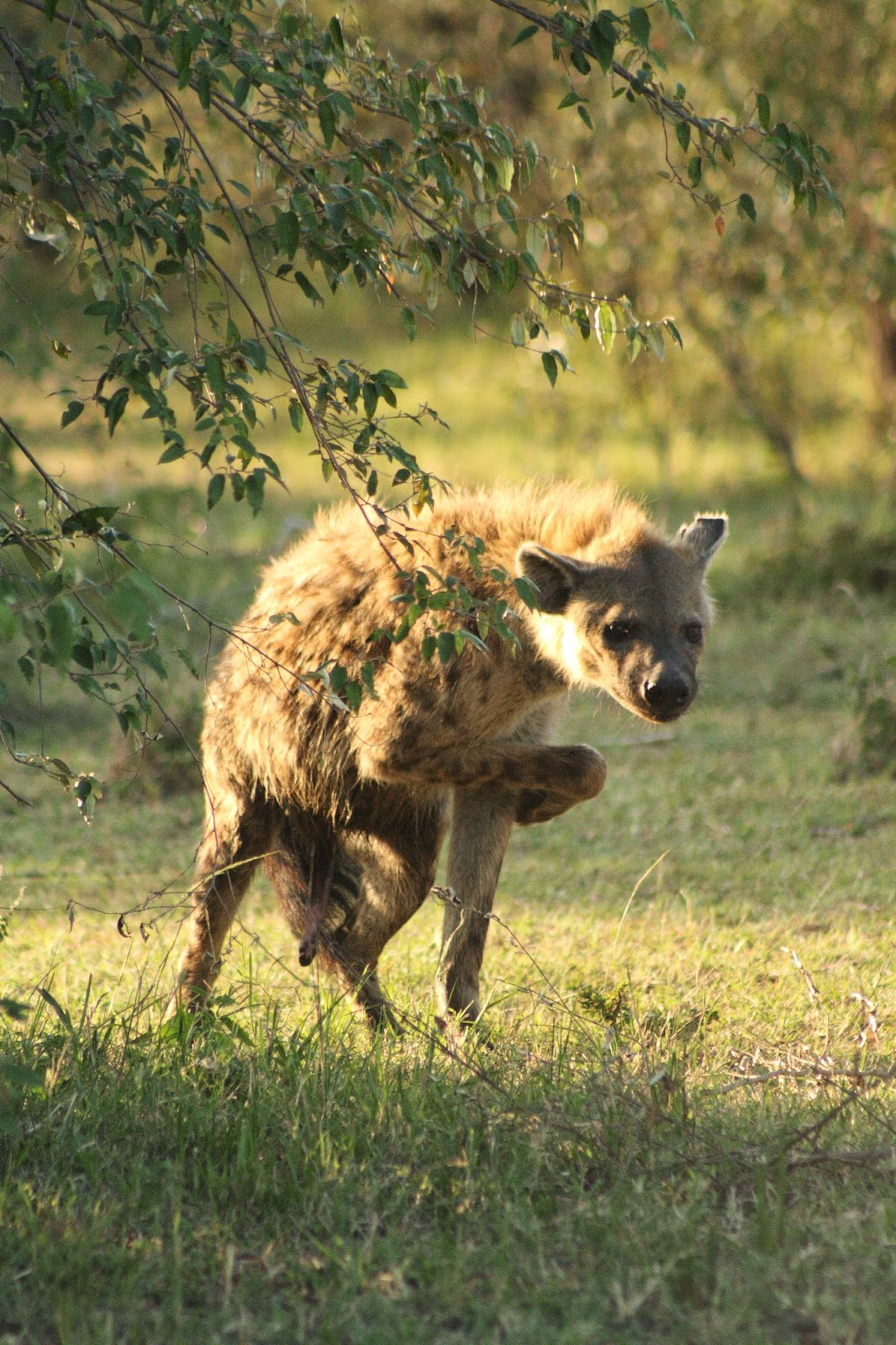
Friday, December 12, 2014

Things Hyenas Survive

In the natural world, it is survival of the fittest.  We see a ton of crazy animal injuries out here:  various antelope missing horns; lots of limps; zebras with misaligned stripes, clearly due to barely slipping out of the grasp of a lion’s claws; and lions gored by warthogs.  None of these come close to comparing to the crazy injuries that we have witnessed hyenas surviving.

Hyenas are tough, REALLY tough.  They have an amazingly impressive immune system and we don’t even yet fully understand how it works as well as it does.  Most hyenas carry the antibodies for rabies.  This means that they contracted and fought of the disease, but we don’t ever see them come down with symptoms and start acting rabid.  Canine distemper, a particularly nasty virus, does not appear to bother hyenas much.  While epidemics are decimating lions and wild dogs, we only have a few hyenas go missing.  We also know that they can eat anthrax.  Anthrax! 

Like I said, hyenas are REALLY tough.  This blog is devoted to all the things that we have seen hyenas survive.

Kay loves to tell us the story of her favorite hyena, Cochise, and how she survived being bitten on the nose by a cobra.  As Cochise stumbled out of sight into the bushes, Kay thought she would never see her again.  Less than a week later, Cochise was spotted looking perfectly healthy and completely recovered.

We all know about Navajo.  She has survived 22 years of tough living.  I mean, just look at her:

Navajo, surviving life, one day at a time
Moon Pie survived being kicked in the face.  Her jaw was very clearly broken, she couldn’t eat, and we watched her get skinnier and skinner for weeks.
Moon Pie: Her face so swollen her right eye is shut
We thought for sure she wouldn’t make it, but the swelling went down and we knew she was out of the woods when we saw her stripping meat off of a fresh carcass that another hyena had taken down.  The offset of her jaw, once fully healed, is a testament to how bad the injury was and how tough she was for pulling through.

Moon Pie, looking skinny but all healed up
We have had a couple cubs survive orphaning.  Our most recent tough little survivor, Cyberman, is still going strong, despite losing her mom to one of the worst hyena poisonings in project history when she was only seven months old (hyenas usually rely on mom’s milk until they are at least twelve months old). 

Hyenas also survive a crazy number of intense physical injuries.  
Peebles with a nasty-looking gash on her head
Harpy, in addition to having a huge goiter-like growth on her neck, has some awfully painful looking scars.
Harpy's goiter and some impressive scars
More scars on Harpy's left side
Snares are a common, nasty injury for hyenas, especially in places where poaching is prevalent.  Hyenas often get caught in snares meant for other animals.  They usually manage to escape the snare’s tether, but then they are stuck with an ever-tightening loop around their neck.  Eventually, the snare cuts into their neck, creating an open festering wound that can cut off the wind pipe or make it impossible to swallow chunks of meat.

An old Talek West male, Oakland, survived one such snare.  The snared worked its way into his skin and was imbedded there.  We darted him, in an attempt to remove the snare, but it the wound had healed over and it was too deep to safely remove.  The snare has remained there ever since.  When Oakland whoops, you can hear the snare resting on and interfering with his vocal cords.

In contrast with Oakland, Bruno’s snare was NOT healing over.  When we darted him, it was an open, festering wound that circled his neck. 
Bruno's snare

Another close up
Some close-ups of Bruno's snare


Removing the snare


Luckily, (and as a testament to how tough hyenas are) Bruno is looking great these days.  You can still see the hole in his windpipe, but otherwise he seems right as rain.


In case you didn't believe me before, I bet you do now.  Hyenas lead a rough life and they have to be REALLY tough to survive it.  It's no wonder they occur in so many habitats, adjust reasonably well to human presence, and are not declining like many other large African carnivores.

Monday, December 8, 2014

A Dating Guide for Male Hyenas

In spotted hyena society, adult males are ranked at the very bottom of the clan hierarchy.  That means that when it comes time to find a date, the males have A LOT of work to do to impress a female.  Male hyenas are generally terrified of female hyenas, and the prospect of having to approach – let alone court – a female can elicit actual shivers of fear.  Here are some of the tried-and-true tactics in a male hyena’s dating arsenal:

Approach/avoid behavior: A male hyena approaches a female (who is usually ignoring him), and once he gets close to her, he backs off a few meters as if suddenly startled.  He often repeats this over and over for minutes at a time, sometimes never even getting close enough to sniff or groom the female.  As Leslie described in an earlier blog post, the male seems to be thinking, "I want you...but I'm scared of you...but you're cute....but also dangerous..."

The present: This is when a male hyena stretches his body out in front of the female’s nose, letting (or occasionally forcing) her to sniff his side and genitalia.  In this case, he might be too scared to engage in the proper hyena greet, which involves lifting his back leg for the female hyena to sniff.  This would leave him in the precarious position of standing on only three legs, and when interacting with a female hyena, he wants to be prepared for anything!

Grooming foreleg: Gotta keep those legs sparkling and clean!  Female humans are expected to shave their legs, and male hyenas are expected to groom theirs.

Pawing the ground: Hyenas have scent glands between the toes of their front feet, and a male hyena will paw the ground in front of a female to deposit his sexy-smelling scent where she might notice it.

Bowing: This is my favorite hyena courtship behavior, and I recommend it for males of all species.  A hyena male lifts one foreleg and crosses it over the other while facing the female.  It is ridiculously adorable, especially when she completely ignores him.

Kyoto bowing for Pan, who is sacked out in a bush.
So, so cute!!
And finally, the part you’ve all been waiting for…hyena sex.

In spotted hyena mating, a female hyena retracts her pseudo-penis into her abdomen and stands as still as possible, while the male stands on his hind legs and clasps her sides with his front paws for balance.  He then flips his erect penis towards her abdomen, squatting and hopping around on his back legs as he tries to find the correct position.  After his penis penetrates her urogenital canal (intromission), he thrusts upwards until ejaculation.  His penis usually swells up during mating, preventing him from pulling out, so he then rests his head on her back for a bit and they relax before separating.

Last week, I was lucky enough to see a mating while driving around in the area between Sarova Lodge and Sekenani Gate.  Matings are super rare for us observers to see because they usually occur on the outskirts of the territory.  These hyenas, however, were exhibitionists, and did it right by the road!


In the "thrust" of the action.
Post-copulation rest and cuddle time.
For another rare mating account, see Meg's previous blog post on a special moment between Agent Orange (female) and Euclid (male) in Serena's Happy Zebra clan!

Friday, December 5, 2014

Canids of the Mara


While African savanna ecosystems are generally known for their large cats, there are a number of canids to be found here as well. Contrary to popular belief, hyenas are not among them; hyenas are in fact more closely related to cats than they are to dogs. Today we temporarily depart from the world of hyenas, however, and instead explore some of the canids to be found in the Mara.

Jackals are the most common of the canids running around the Mara.  These small social dogs live in pairs that breed, den, and raise offspring together. The jackals are ubiquitously omnivorous, feeding on insects, fruits, and small-to-medium sized vertebrates. Despite the common misconception that jackals are purely scavengers, they have been found to hunt the majority of their own food. The two types of jackals most often seen in the Mara are the black-backed and the side-striped jackals.


Juvenile black-baked jackals

Black-backed jackal: The black-backed jackal is the more social and more aggressive of the two frequently seen Mara jackals. They live in family groups of breeding pairs with dependent offspring, sometimes with young adult and subadult ‘helpers.’ They are adept cooperative hunters that frequently kill small and medium sized mammals. Black-backed jackals have earned their reputation for boldness by frequently stealing food from much larger carnivores like lions and hyenas, as well as through their aggressive defense of their dens. I personally have seen jackals bite hyenas on multiple occasions! Their comfort around large carnivores makes them particularly well specialized for open savanna ecosystems, which is their primary habitat.

A family of black-backed jackals
Two black-backed jackals in a scuffle over a scrap
A stare-down between Kyoto and a black-backed jackal


Side-striped jackal: The side-striped jackal is more solitary and more nocturnal than the black-backed jackal. While they too live in family groups, they usually forage alone and at night. As such, they are a significantly rarer sight here in the Mara. They are more omnivorous than the black-backed jackals and are found in more diverse habitat covering more of Africa. Although the side-striped jackal is larger than its black-backed relative, the black-backed jackal is dominant to the side-striped jackal and usually wins during disputes over food.  Because of their nocturnal habits, I have seen very few side-striped jackals during my time here. Recently, we saw both side-striped and black-backed jackals at a Talek West carcass. Unsurprisingly, the side-striped jackal kept a healthy distance between it and the two black-backed jackals, who eventually chased the larger canid away.


Bat-eared fox: The third commonly seen canid in the Mara is the bat-eared fox. These foxes are characterized by their large ears, which are used for locating invertebrates, their primary food source. Like the jackals, they live in family groups consisting of a bonded pair and their recent offspring. These foxes are found mostly in arid savanna ecosystems and specialize in eating harvester termites, a lifestyle to which they are extremely well adapted! In addition to their large, sensitive ears, they also have thick fur to ward off biting insects and sharp claws to ease excavation of termite mounds. Their 46 to 50 sharp teeth allow them to quickly chew potentially harmful insects, and their uniquely muscled jaws allow their mandible to close five times per second! While these dietary adaptations are truly impressive, the bat-eared fox’s crowning achievement is its adorable little face.


A family of bat-eared foxes
A bate-eared fox peaks out of it's den hole
While the above-mentioned canids are the most commonly found in the Mara, there is another dog that can be found in the park: the domestic dog. Increasingly, we are seeing individuals and groups of dogs foraging inside the parks boundaries. When taken out of the context of human development and placed into a habitat full of wild animals, these dogs quickly appear a great deal less domesticated.


Wednesday, December 3, 2014

Eggz-actly

Hyenas are known to eat anything. However, their food preferences change with the seasonal migrations. For example, during the great wildebeest/zebra migration (about 3 months from July-September) hyenas feast on the traveling creatures with zealous (Cooper et al. 1999).

Roswell looks fat (and dapper!) after gorging on a wildebeest kill.
But, when the wildebeest and zebra start to dwindle, hyenas are back to boring old Tommies (thomson’s gazelle), Topis, and desiccated leftovers (aka that old wildebeest from a month ago.) In the Talek area, the hyenas seem to appreciate beef as a protein source as cow populations increase. Additionally, hyenas occasionally enjoy termites. Apparently they take the advice of your nagging nutritionist: they have a varied diet. One that includes ostrich eggs!

It was a morning obs in October (after the migration), when we plodded along Fig Tree territory searching for a clan that likes to go missing. Suddenly, we noticed a strange sight: hyenas! Also, hyenas chewing on what looked like oval shaped white bones. But, these were not bones...these were eggs laid by the largest bird on earth, the ostrich. (Fun fact: an ostrich egg can weigh up to 1.4 kg! That's 3.08 lbs for all my fellow Americans out there. For comparison a chicken egg weighs 1.5-2.5 oz. Imagine an omelette made from an ostrich egg...but I digress.) Whilst a group of female ostriches watched cautiously nearby, the hyenas attempted to devour the eggs, with little reward shown clearly by the pictures below.

The hyenas were wary of the eggs at first and approached with apprehension.

Mansalow attempts to crack open the egg...

And is quite disappointed with the outer shell's taste.
He tries gentle and cautious chewing, apparently a poor technique to ostrich egg cracking.

He decides to paw it around for a bit, maybe break it open that way.

Embarrassed, Mansalow is caught in his failure.
The hyenas would gently place their mouth around an egg and then attempt to chew softly. It was similar to how I must have looked when I tried to put a whole orange in my mouth (a likewise unsuccessful situation.) Unfortunately, we did not see any of the hyenas break open an egg and taste the yolky goodness of the treasured prize.

It appeared that the hyenas could not get their mouths around the eggs with enough leverage to crack them. Because Crocuta crocuta have an extremely powerful bite force, it seems unlikely that they can’t open an egg due to its durability. Rather the shape may be the tricky part.

It just goes to show that Mara hyenas tend to get a little ansty after the wildebeest leave and may even try vegetarianism.

The lady ostriches were not too happy with the hyenas behavior.


Cooper, S.M., Holekamp, K.E., and Smale, L. (1999). A seasonal feast: long-term analysis of feeding behaviour in the spotted hyaena (Crocuta crocuta.) East African Wild Life Society, Afr. J. Ecol: 37, 149-160.


Michigan State University | College of Natural Science