Monday, November 17, 2008

Ever wonder what 7,000 pounds of meat look like?

Once upon a time, a hippo lived in a water hole about a kilometer north of our camp. One night, that hippo went out grazing, as he did every evening. Unfortunately, he never made it home. A group of hungry lions were lying in ambush, and hunted the hippo down just a few hundred meters from his little pool.


In the interest of science, I've decided to document where those 3 tons of hippo meat go, day by day. Here's the carcass about 12 hours after the hippo was killed. Two male lions were at the kill, and from the size of their bellies, they had apparently been gorging themselves all night.


These guys were already so full that they could barely breathe. They'd nibble half-heartedly on some meat, then waddle away a few feet and lie down to rest and digest.


In 12 hours, the lions have barely made a dent in the massive carcass. However, they haven't had any competition for their prize yet. We'll have to wait to see what happens overnight.

**By the way, I know not everyone is as interested in seeing photos of carcasses as we are. If these posts get too gross, comment and let me know!

Sunday, November 16, 2008

Scadoxus multiflorus, a.k.a. Flowerus Wickedcoolus

I know I said my next post would be the follow-up to my last one about Maasai education, and I am hoping to get to that soon, but in the meantime, how awesome is this plant? It's colloquially called a blood flower or a fireball lily, and it's a poisonous perennial found throughout tropical parts of Africa. Here are a couple photos of one that's growing in camp. The photos don't give a good sense of scale, but the diameter of the flower is probably a good eight inches. For more info, visit http://www.plantzafrica.com/plantqrs/scadoxkath.htm (duh, where do you think I found its scientific name? field guides are SO passé...).

Friday, November 14, 2008

Battle of giants

Giraffes are odd creatures in many ways. They are one of the only things I know that can look completely awkward, yet subtly graceful at the same time. They are a joy to watch as they go about their business in their slow, yet deliberate manor.

Before I arrived in Kenya, Dr. Holekamp had told me a very interesting story about a giraffe fight she had witnessed. I had high hopes for seeing these giants have a round of fisticuffs. I have been fortunate enough now to see giraffes battle for dominance on two different occasions. Last year I came upon a scene with about 15 giraffes standing around, watching two giraffes slug it out. It reminded me of high school fight, with many people standing around watching, but nobody is brave enough to break it up and most don't want to get close enough where they could become part of the action.


Giraffes have a fighting style only they can have. The swing their long necks at each other, trying to deliver blows with the thick, blunt horns on top of their head. It may look futile the first time you see a giraffe take a swing with its gangly neck, but I am quite sure if you were hit by the swinging giraffe head, you would be out of commission for a long time.


During the most recent fight I witnessed, I had trouble deciding which animal had won the fight. Looking back through the 90 pictures I snapped off in about 5 minutes, it was clear who was the champ. In the battle I saw last year, the fight went on for about 15 minutes, then another contender walked up. One of the two original fighters quickly sauntered away. Contender number two stood its ground, sort of. When the new challenger approached, the remaining contender gently placed its neck over top of the dominant animals neck.


It may seem strange that the subordinate animal would place it neck on top, but after I thought about it a bit more, it made sense to me. With its long neck on top of the dominant animals neck, it was in a completely defenseless position. The dominant giraffe could have easily taken a swing with its wrecking ball head and inflicted major damage. This is how many dominance interactions play out. The weaker animal shows its subordination by placing itself in vulnerable position. This is what I have worked out in my head about giraffe war. If anyone has read or been told differently, I am always interested in learning new things so feel free to write me. Or just see if you can pick the winner in the pictures, the one on the left or the one on the right.


Wednesday, November 12, 2008

Mangey cheetah

Most visitors to the Mara put cheetahs near the top of the list of animals they would like to see. A few visitors are lucky enough to actually see a cheetah or two. Unfortunately, many of the cheetahs in the park are infected with mange. This is a skin disease caused by mites. The mites are passed from animal to animal through direct contact.


Cheetahs are solitary animals and are rarely seen together, unless it is with siblings or their mother. Given the solitary lifestyle of cheetahs and the low density of cheetahs in the Mara (it is estimated there are around 50 cheetahs here), it seems unlikely they would have high enough contact rates to maintain a high prevalence of mange. Domestic dogs that are frequently in the park may play in a role in the spread and maintenance of mange in the wild animals in the park. Mange is also seen in other animals such as buffalo, but to my knowledge, few thorough studies have been done at this point.


Special thanks to Linda Mansfield for her input on mites and mange!


Tuesday, November 11, 2008

What it means to be a Maasai

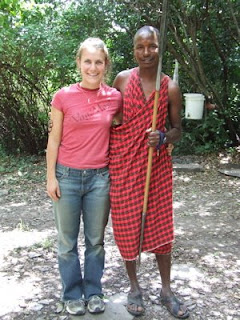
I’ve wanted to write a post for a long time about the culture of the Maasai, the ethnic group that lives in our area of Kenya. I’ve hesitated for fear of being unwittingly politically incorrect, but that seems like a silly reason to deprive readers the opportunity to increase their worldviews. I figured the best approach would be to talk to a Maasai and get the story straight from the horse’s mouth. So I spoke with John (pictured below), a Maasai man who has worked at Fisi Camp for over a decade, and asked him to describe his people as completely and objectively as possible, and he did a great job. So if anyone is uncomfortable with my general depiction or specific word choice (ex, use of “tribe”), please understand that the information is all from a Maasai person himself, and he approved this post before I published it.

The Maasai people are nomadic pastoralists, which accounts for their generally tall and thin body types. According to legend, the first Maasai came from the sky with a cow, so Maasais believe that all cows everywhere (yes, even the ones in Vermont) really belong to them. They therefore have a very strong attachment to these cows: as John put it, “A Maasai without a cow is not a Maasai.” In fact, cows are the standard of currency among Maasai: one average-sized cow is equivalent to about 10,000 Kenyan shillings or about $150 USD.

The traditional roles of men and women are pretty, well, traditional. Men are the heads of families and the community leaders, and are in charge of the cows and providing security for the family. Women (“mamas”) care for the children and the house, collect firewood and water, do all the cooking and washing, buy food at the market, and build all the huts out of dried cow manure (it can take two women about six months to build one home). Boys often herd cows, but girls have many more responsibilities, as they are expected to help their mothers pretty much as soon as they are physically able to (it’s not uncommon to see a child as young as four or five caring for a younger sibling).

Historically, education has not been a priority for the Maasai. There is much more to be said on this topic, so I’m going to save it for my next post, so stay tuned for that. For now, suffice it to say that the Maasai have traditionally been unenthusiastic about educating their boys, and extremely reluctant to educate their girls. Instead, girls are circumcised at the young ages of 10-13 years old (more on this next time, too). Once they have been circumcised, they can then be married off to men of between 16-40 years old. The bride is not given a choice in whom she marries, and the bride’s family typically receives between five and ten cows as payment. Mamas then begin bearing children at around age 15. Multiple wives are seen as a sign of affluence, although as more and more Maasai become Christian, this custom is becoming less common.

Maasai men are typically grouped in “age sets,” which are cohorts consisting of men who are all within several years of each other. A person’s cohort is a big part of his identity, and each cohort has its own songs and dances that are used in celebrations. The time-honored custom has been that when boys are between 16-20 years old, thousands of them will be circumcised together as one cohort. This cohort will then live together and train to become Maasai warriors, and those who are able to kill a lion single-handedly become the most superior warriors. Warriors are then responsible for protecting the tribe from other marauding tribes. However, in recent decades, since the Maasai’s inter-tribe conflicts have subsided almost entirely, the need for warriors is diminished. That fact, combined with the government’s credo that “all children must attend school” (a law that is not enforced in rural areas), has made Maasai warriors slightly obsolete and much less common.
The spoken language of the Maasai is Maa, and although John, who speaks four languages fluently, happily claims that it is “not hard,” I can attest that for native English speakers, it is extremely difficult, because many of the phonemes are so different that we physically can’t form them with our mouths. (Swahili is much easier, because it’s based on the same alphabet and phonemics as English.)

The predominant foods are milk (cow’s) and meat (cow and goat), and chai tea is both a nutritional and social staple. Fresh cow’s blood is also a popular traditional drink, especially for women who have just given birth so that they might replace the blood they have lost. Fruits and vegetables have really only entered the menu in a substantial way in the past decade as imports and transportation to rural areas have increased.

Maasai mamas usually wear wrapped skirts and cloths, and both men and women wear “shukas,” which are all-purpose shawls that can protect against the sun and the cold. Interestingly, Maasai in different areas have different colors that dominate their wardrobes. In our area, the major color is red with hints of yellow, but the Maasai in Tanzania wear predominately blue with hints of white. The Maasai are also famous for their beaded jewelry, which comes in all colors and can be quite elaborate. The mamas are very skilled and make all of the jewelry by hand. Some of it has special significance: for example, the large circular necklaces are bridal necklaces, and men who have lost their father will wear a metal bracelet on their right arm to honor him. On special occasions, Maasai will wear their most formal garments and adorn themselves with dozens of pieces of this beautiful jewelry.

As I’ve hinted throughout this post, these times, they are a-changin’. Since the Kenyan government privatized most of the grazing land, the Maasai have become significantly less nomadic and have formed more permanent communities. Some are branching out and have started to cultivate crops such as wheat and maize (not in Talek, our local Maasai community, but in other parts of Kenya). Likewise, as more Maasai get educated, more are opening small businesses and shops. Additionally, the increase in education has started to reverse what has historically been a lack of involvement and interest in politics. It’s also getting more common to see Maasai wearing western clothing.

I asked John what, above all, he wanted to communicate to Americans about the Maasai people. He said that they are very brave, very proud, and very honest. He said they are not as prone to theft as other tribes, and have excellent manners. They are also extremely friendly, and welcome members of other tribes who come to live among the Maasai.

I couldn’t have said it better myself.

Monday, November 10, 2008

Hyena Myth #1: Busted

Let’s face it, hyenas are weird. And, while their bizarre qualities are what we scientists can’t get enough of, they’re also the reason that hyenas have been forever loathed and misunderstood. There are more myths surrounding hyenas then I can count, but we’ll start with one of the strangest and most common....

Yesterday, a safari guide stopped us on the road. He said, in a hushed tone (like many guides, he liked to pretend he knew everything and didn’t want his clients to hear him admitting uncertainty), “Is it true that in hyenas, males and females are, you know…one?” It wasn’t the first time I’d heard this question, and I’m sure it won’t be the last.

While males and females are not, in fact, “one,” hyenas do have a definite physical peculiarity: the two sexes have nearly indistinguishable genitals. That’s right: female hyenas have “pseudopenises” - completely capable of erections – as well as “pseudoscrotums” made of fatty tissue. Don’t say I didn’t warn you…I told you they were weird.

In fact, if I didn’t know any better, I’d buy into this whole male=female thing too. Check out the hyena below…that, dear readers, is a female hyena in all her male-mimicking glory.


Imagine seeing that hyena nursing a cub or – stranger still – giving birth. That’s why, for millennia, people have thought that hyenas had both male and female organs, a biological phenomenon called hermaphrodism. This sexual ambiguity, popularized by writers from Ovid to Hemingway, has made hyenas the subject of confusion, fear, and mistrust.

While hermaphrodism may seem like material for freak shows and science fiction novels, it’s actually somewhat common in the animal world. Picture this (I liked Leslie's hypothetical "Carl" story, so here goes): you’re a female sea cucumber that lives on the ocean floor and rarely comes into contact with another sea cucumber. But, you'd really like to fulfill your biological destiny to mate before you die. You may wait days, weeks, or months to see another sea cucumber…so let’s hope it’s a male! OR you could be a hermaphrodite with the potential to be both male and female…that way, no matter who you run into, you’ll be able to fill the ocean with lots of adorable baby sea cucumbers.

However, hyenas certainly aren’t solitary, and they encounter members of the opposite sex dozens of times a day, so hermaphrodism wouldn’t be a real advantage here. Instead - despite all appearances - hyenas follow the standard mammalian pattern of having two distinct sexes: males and females. While scientists as far back as Aristotle have tried to clear up the confusion, their rational arguments have been drowned out by images of female hyenas’ uncanny “maleness.”

Of course, if you’re even slightly scientifically-minded, this brings up the obvious question: why do females have pseudopenises? Well, we're still working on ironing out the details of that one. If you've got a definitive answer, let me know, and I'll have a PhD in the bag.

Wednesday, November 5, 2008

Kenya rejoices

Yes, I know you can’t go for 5 minutes today without hearing about election results, but here in Kenya, there’s no talk of electoral votes, senate seats, or partisan politics...there's only celebration. As much as the political commentators are touting the “historical” implications for the US, I’m pretty convinced that this morning was just as momentous for Kenyans as it was for Americans, if not more so. No matter what side of the political fence you’re on, you can’t deny that Barack Obama’s candidacy has instilled pride, hope, and a sense of unity in Kenyans.

Audrey and I gave our hyenas the morning off and went to watch the election returns in the Serena Lodge staff quarters, which quickly filled with rowdy Kenyans. When CNN projected Obama as the winner, a deafening roar broke out and free Cokes (it was just 7am, but that didn’t matter) were passed around. As we watched Obama’s acceptance speech, the room alternated between captivated silence and boisterous cheers.

For the last several months, Obamania has indeed gripped this country. Locally-brewed “Senator” beer has been dubbed “Obama” beer. In the roadside markets, kangas (traditional fabrics with bright patterns and Swahili sayings) now bear portraits of Obama and the phrase Yes We Can. As a foreigner, the first question I get is “What country are you from?” When I reveal that I’m American, the follow-up is inevitably, “So you must know Obama!”


But to Kenyans, Obama is more than just a local guy making good. After the political instability that ravaged the country earlier this year, this morning’s results reminded Kenyans that democracy is possible, and that elections can accurately reflect the will of the people. Our Serena camp attendant, Philomen, said (this is a translation from Swahili, so forgive me if I misquote you, Phil!) “Here, our election was stolen from us. In America, the right man won.”

I won’t pontificate here on whether the right man won or not. But, I will say that, after the horribly divisive events here in January, it’s been amazing to watch Kenyans unite behind a common cause. Even the bickering government has banded together and unanimously declared Thursday a public holiday to commemorate their countryman's success.

So no matter what your political views are, tomorrow you should kick back, relax, and celebrate Kenya’s newest holiday…we’ll have an extra “Obama” beer on your behalf.

It's only natural

When I posted the photo of the obese hyena on Halloween, an astute reader posed the question of if she might get diabetes from being so fat. An excellent question!

The short answer is no, probably not. First of all, hyenas can go from "fat" to "normal" and back pretty quickly...they are capable of gaining an astounding 20kg in a single meal (that's 44 lbs. for those not metrically-minded). To give you some perspective (if you still need any after reading "44 lbs."), that's about 130 hamburgers, and at least three times as much as I can eat at Thanksgiving. Obviously that's not all retained as fat, although after such a gorging they will stay fat for days (Navajo, the hyena in the picture, is just now starting to return to her normal, albeit heavy, weight).

But back to the question—can hyenas get diabetes from being so fat, even if they're only fat sometimes? Well, I'm sure it's possible, but the truth is that most wild animals don't contract diseases like diabetes or cancer. That's because the selection pressures (yes, selection as in natural selection) are too strong. In other words, if there were a hyena that got diabetes from obesity—let's call him Carl—it would probably be because Carl had a genetic mutation predisposing him to the disease. Well, Carl certainly wouldn't fare very well against the other hyenas in The Game of Life, since he would be too busy trying not to keel over in a diabetic coma. Carl probably wouldn't produce as many offspring as other hyenas. In fact, maybe Carl would die before he had a chance to produce any. Bummer for Diabetic Carl, but less of a bummer for the hyena population's next generation, because now those genes for diabetes have gone with Carl, without getting passed on. In other words, they've been selected out. This is also why animals don't typically get diseases like cancer.

Okay, so why do we get cancer? By now you have probably caught on and guessed, because if you're reading a blog about hyenas you're most likely in touch with your Inner Science Nerd, but I'll elaborate nonetheless.

Humans are subject to natural selection just like any other species, but we have a special knack for relaxing (weakening) it. We have developed a million different medicines, medical treatments, and other life-saving and life-prolonging tactics to help us overcome things that would have surely done us in a couple hundred years ago. Think about it—a few hundred years ago, if you got the flu, things didn't look good for you. If you had a difficult childbirth, you and your child were in serious danger. And if your body stopped producing insulin, well, you were pretty much out of luck. It's therefore no surprise that life expectancies were half what they are today.

Today, thanks to technological advances, we're able to look natural selection in the eye and say "Pfff! Bite me!" Okay, it's not exactly like that, but the selection that operates on us now is so weak that it can be almost impossible to detect. I've had the flu, as have most of you, and I'm confident that if I can't pop a baby out naturally, my obstetrician can come up with some kind of a solution. And although diabetes is a very serious health condition, it is now something that people can commonly live with if they take proper precautions (and live in a country that doesn't mind insuring all its citizens...whoops, sorry, slip of the tongue). As for cancer, most wild animals—like humans not that long ago—never live long enough for cancer to get them. Those that do get it die pretty quickly, so the ones that are less likely to get cancer are the lucky ones who get to pass on their genes.

I don't mean to imply that natural selection doesn't act on humans at all any more, because it certainly does. It can just be a lot slower and a lot more subtle than it used to be. This is why human overpopulation is such a problem—we've removed many of the natural population controls. But that's a story for another day.

**Special thanks to Andrew S. Flies for his input on this matter.

Sunday, November 2, 2008

Ant in the pants

Here is the follow-up to the recent posts about the marauding ants in Fisi Camp. The hyena researcher was unlucky enough to have a soldier ant bite into her foot. Luckily for everyone else, she was nice enough to let us photograph her fending off the attack. I can think of a lot worse places to be bitten than in the foot!


Saturday, November 1, 2008

Tragedy strikes

NOTE: The sentiment among the bloggers at FisiCamp is that we really want to give you an accurate depiction of what happens out here, and that means writing about both the highs and the lows that we experience. While I’ve tried to spare you most of the gory details, just be advised that this entry does illustrate the harsh realities of life out here. It redeems itself somewhat at the end, I promise…
----------------------------------------------------------------------------------------------

The hardest part about studying animals occurs when, all of a sudden, you’re reminded that they aren’t invincible. Despite the fact that hyenas are amazingly feisty and resilient animals, they live difficult lives.

When we spotted Geezer, we immediately knew something was wrong. He was trying to walk into a shallow water hole, but he could barely move. He was moving slowly and laboriously, and it took a long time for him to reach the edge of the pool. As he bent down to drink, blood ran down his neck from several puncture wounds, and the water around him turned red. Geezer drank laboriously for several minutes, which wasn’t a good sign - healthy hyenas don’t tend to drink much.


From the size and shape of the punctures on his neck, as well as other wounds on his back and hindquarters, we could tell that the poor guy had been attacked by lions. He’s from the Happy Zebra Clan, whose den was visited by lions not long ago. Recently, we’ve repeatedly seen a group of five large male lions in the heart of the clan's territory.


To make a sad story short, Geezer didn’t make it through the night.

Out here, we walk a thin line between being animal enthusiasts and scientists. As animal lovers, we inevitably grieve when a hyena dies. These hyenas become our family and our closest friends. We know their favorite hangouts, their friends and foes, and their funny quirks. We see them day after day, carrying on with their lives, and it’s impossible not to get attached.

Unfortunately, rule #1 in research is “don’t get attached,” because our jobs don’t just end when a hyena dies. We can learn invaluable information post-mortem, so we have to retrieve the body, perform a necropsy, and prepare the skull to be sent back to the US. As scientists, we have to (at least attempt to) distance ourselves from the situation; it’s a strange and difficult balancing act between emotion and obligation.

But, all is not lost. In an ironic twist of fate, the same day Geezer died, we had our first sighting of Quark, the newest cub in the Happy Zebra Clan. The coincidental timing of Geezer’s death and Quark’s birth was a perfect reminder that, while nature can be harsh, new life is just around the corner.


Michigan State University | College of Natural Science