Wednesday, July 24, 2013

Winter in Kenya


The migration is here and with it hot dry winds and brisk chill nights. It has not rained since the herds of wildebeest started to arrive and every car kicks up a cloud of dust behind it, visible from many kilometers away. The grass is parched and yellow though the massive seas of grass (where I can see nothing but grass in every direction) are starting to get grazed down. No longer are the sounds of the river and the wind the only things I hear- now the gentle lowing of wildebeest and kwa-kwaing of zebra echo in the distance.

When the zebra cross the river they do it slowly and carefully- but not without excitement. They gather on the banks until that critical mass has been reached and then finally one will take the first step into the river and start to wade across while the young ones are forced to swim. The river is not that high this year- many of the adults do not have to swim at all- but it is still high enough to take its toll.
Photo: A crocodile attempts to take down a zebra (unsuccessfully in this case).
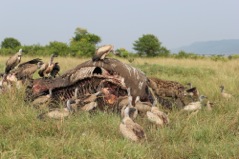
When the wildebeest cross they do so with speed, as if without it they would not have the courage to cross at all. They kick up massive clouds of dust as they stampede towards the river and enter it without a glance, seemingly without planning or foresight. They scramble up the opposite slope as the dirt crumbles beneath their feet and sends many of them plunging back into the water. The carcasses are starting to pile up, catching on the rocky sections of the river and bloating in the sunlight. The vultures are ever-present hovering on the river banks, picking at the dead. Every vulture in Kenya is in the Mara now to enjoy the feast and marabou storks are a common sight. The crocodiles do not have to work very hard, in the frenzy of the crossing many wildebeest are trampled and drown. The many egrets, cranes, storks, and plovers that riddled the wet areas of the landscape a month ago are now a rarer sight.

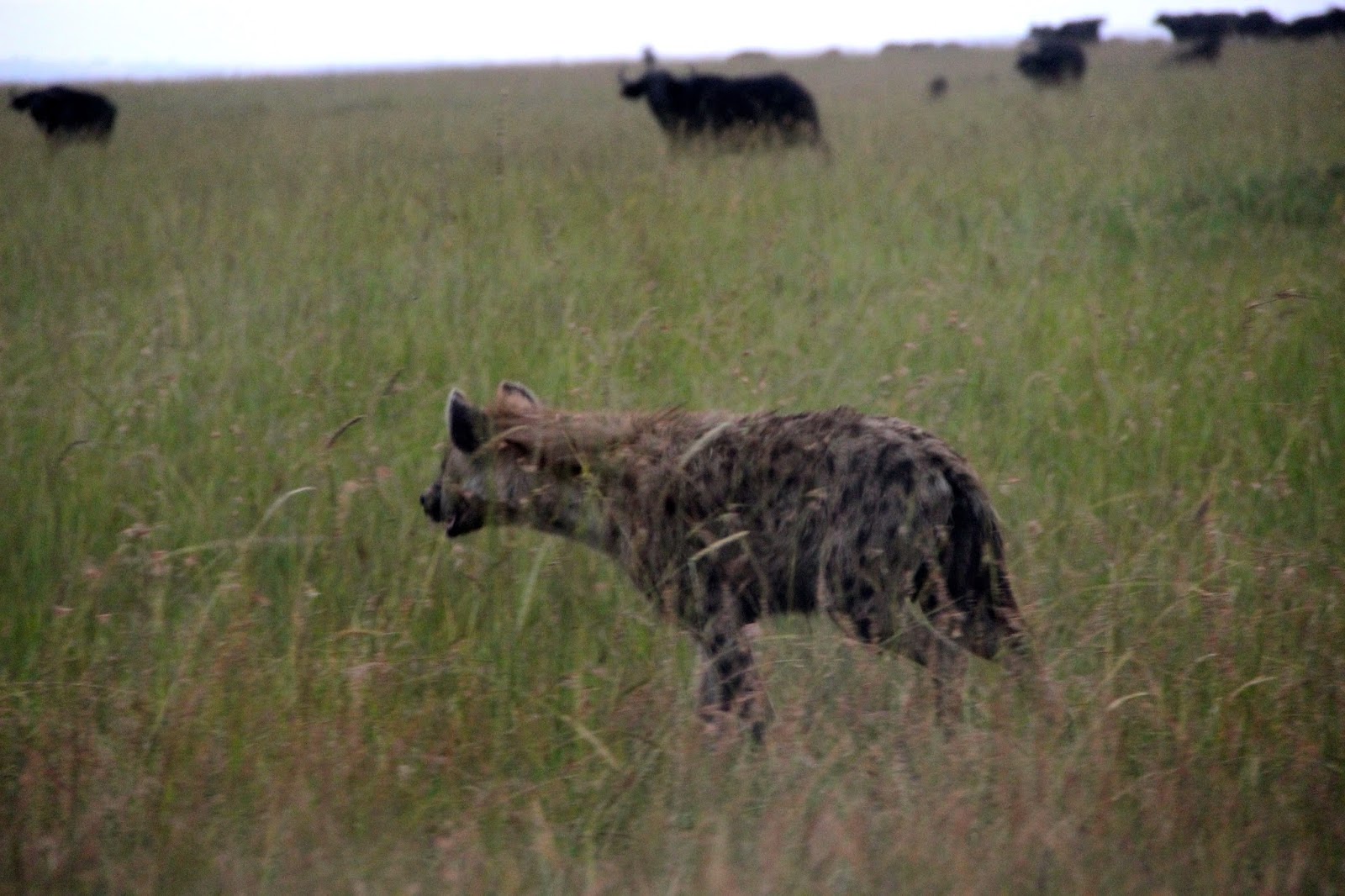
Beyond the river and the lions and hyenas are getting fat. I have not seen a single dead zebra yet but there is at least one wildebeest carcass being eaten every day by the hyenas or the lions. This morning as some of the wildebeest were milling by the edge of the river, having recently crossed, we see lion ears poking out of the grass. A flash of movement and a young lion is leaping towards the scattered wildebeest. We drove closer and in another flash this lion has leaped onto the back of a wildebeest and taken it down. This is a group of four lions, a mother and three subadults. The wildebeest thrashes about for twenty minutes while the mother lets the subadults practice their killing grip.
Photo: Three north hyenas (Lady on the right) feed on the remains of a wildebeest carcass. 

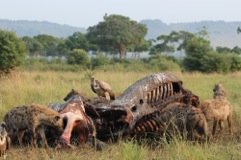
The other day we came upon a freshly dead wildebeest with three hyenas feeding. The eyes were gone and the guts spilled from the belly, starting to balloon out in the heat. Carcass sessions do not have the same level of aggression, everyone has eaten recently and no one cares to squabble. Other animals show up occasionally but they are already fat and do not even bother to come close. Every inch of free space is starting to fill up with animals. I'll drive over the top of a hill and suddenly the sight of thousands of wildebeest and zebra is spread out in front of us fading into freckles on the horizon. As we drive along a track a few thousand wildebeest are glistening wet in the sunlight and loping across our path into the distance, like a living river they move away from the Mara, the survivors. We drive towards them and the herd moves smoothly, splitting around us until they gallop in front and behind us and then suddenly we are through and the gap we made seals itself without a sound. We drive on.
Photo: Ratchet carries a wildebeest tail while Lady follows.


Clouds build on the horizon in the afternoon and the low rumble of thunder greets the night but the storms stay away from this half of the Mara, instead they skirt the escarpment and we see lightning flashing in the highlands beyond. Still no rain. Wildebeest fill the small luggas and waterholes, covering their shiny coats with what mud is left. The sun is bright and scorching most days- other days the air is thick and hazy with smoke from fires in the south. A dusty sheen coats everything and anything beyond a kilometer quickly fades into the dust. The sky is brown and only if I look straight up can I see the blue peeking through. The dust from the hooves of a thousand grazers fills the air and merges with the smoke that covers the horizon. The light takes on a strange orange and brown glow- it is both stunningly beautiful and eerily surreal. At night the full moon rises and casts a strange white glow across the landscape, flashlights and headlamps rendered unnecessary. In the morning the moon sets slowly into the purple haze on the western horizon against the sea of yellow grass, aglow with the light of the the rising sun. 


Happy zebra hyena clan and north hyena clan have both moved dens. Happy zebra to a den just 500 meters away from their first one, a little further from the road and a little more tucked into the valley between two broad hills. Perhaps it is a little more private from the many steps of the wildebeest? North has moved down closer to the river to a den that is surrounded with thick nyazi grass with a few ideal flat open patches for socializing. Neither clan has to move far to hunt and feed now, food is on their door steps and even the males and subadults are fat. All the tracks are dry making it easy to travel to each corner of the territory but this time of year it is not necessary. Wells are starting to get low and eyes search the sky, wondering if those clouds blowing in will bring the rain here. Weather is very localized in the Mara - it may rain at the oloololo gate and be bright and sunny at the south gate on the same day.
Photo: Log Cabin (adult) and George Costanza (cub) with a carcass at the den.
Photo: The mara river, viewed from above.

A genet has shown his face in camp, being so bold as to approach the lab tent while we sit at the table with the light on. He briefly meets our gazes, ascertains that we do not have any food and continues on his way down to the kitchen tent. He has no luck down there either and we see him skirting the trees and disappearing into the darkness. During the day banded mongooses and dwarf mongooses befriend us, scurrying throughout camp and occasionally attempting to get into trouble. I don't mind them for it means that we will not see any snakes in camp while they are there. We did have a black mamba in camp last week, just a glimpse of twisting black flesh in the grass and leaves as it continued on its way through the woods.


The elephants have left now that the migration is here. They do not care for the thousands of noisy wildebeest invading their home and they have gradually disappeared from the area, slipping away quietly without a backwards glance in a way that one would not think to associate with creatures the size of elephants. I have learned that elephants have a unobtrusive manner about them that somehow causes them to blend into the background such that you hardly see them until they flick an ear or turn their heads and you catch a glimpse of white tusk. Unless it is night time and you rudely interrupt the herd as they cross the road. Then elephants are the scariest and most dangerous thing in the Mara as they flare their ears and raise their trunks to trumpet their anger at your noisy intrusion into their quiet lives. 
Photo: Log Cabin (adult) and George Costanza (cub) relaxing early one morning.

The youngest little black cubs are starting to get their spots and show their faces to the rest of the world. While their mothers sleep by the den holes they boldly step a few meters away then run, trip, and tumble back. They are quite the curiosity to other hyenas who steal careful glances at the mother and then gently lick and play with the newest member of the clan. The males have started showing up around the den more often too, perhaps drawn by the females whose cubs are graduating or perhaps with full bellies they just have more time on their hands (paws). Matings and immigrations (of new males from other clans) tend to peak around the migration. They too show high curiosity towards the cubs but the adult females are quick to chase them off if they get too close and then the cubs join in the chase as if it's a game - keep the males away! 
Photo: Ypsilanti (left) cautiously approaches Log Cabin (right) and George Costanza (cub). 

At night I've been zipping up my tent tight, no longer allowing the gentle night breeze to sooth my dreams. Nights are chill now and I pull on sweatpants, a long sleeve shirt, and pile on the blankets. Waking in the darkness at 5:15am is hard, and putting my feet down on the floor of my tent in the cold night air is difficult. But when I unzip my tent to step outside and relieve myself in the woods the gentle scent of forest in the morning fills my senses and I scan with my light quickly (looking for eyes) while the smells and sounds of the Mara invigorate me. By breakfast time I have peeled off my layers and retreated to the shade of the lab tent. Still- no rain.


Tuesday, July 9, 2013

Target, Interrupted

By Moira Donovan, IRES 2013


Hey there! I’m Moira, one of the new IRES students assisting the lab this summer. I’m currently stationed in the Serena Camp, helping with “Target” trials. “Target” is a life-size styrofoam model of a hyena, made by a company that manufactures archery targets—hence his name. Julie, the graduate student whose research I am helping with, uses Target to test hyena “boldness.” Her research focuses on social intelligence (how well a hyena interacts with others in a group environment) and personality aspects that might contribute to it. We measure boldness by observing whether a hyena approaches Target and when the hyena realizes Target is not an actual hyena.

In order to conduct a Target trial, we first need to find a lone hyena traveling a predictable path. We then drive ahead of the hyena, deposit Target along its path, and wait nearby to observe what the hyena does. Two nights ago, Julie, Lily, and I went out on our usual evening observations in search of an opportunity for a Target trial. We drove to the Happy Zebra Clan Territory, hoping to find an unsuspecting individual. I never imagined I would be so lucky as to experience what happened next.

Target and Moira


Soon after entering the territory, we spotted a single hyena loping along. We sat in our seats, deciding whether this would be a proper candidate for a trial, as the hyena rushed across the road and continued in a straight line. Clearly, this one was headed somewhere important. As Lily turned the Hilux off-road and we began to pursue, the urgency of the chase dawned on us – we could hardly keep up at 25kph. We hit a rocky portion, forcing us to slow down, and we were sure we would lose sight of the unidentified hyena. As we maneuvered around the rocks we saw three more hyenas join the first, bolting toward a herd of Cape buffalo. On the outskirts of what must have been 200 buffalo, we saw the hyenas and knew we were going to witness something extraordinary.

Spotted hyenas typically prefer to hunt alone rather than potentially lose their meal to a higher-ranked individual. This time, however, we spotted at least ten individuals when we got there, and a few others arrived in the following hour. Despite our difficulties recording hyena behavior through the darkness, rain, and tall grass, the effects of a large hunting party were clear. While two hyenas warded off an adult buffalo’s charges, several others closed a circle around a fallen calf and began to feed, taking advantage of their allies’ efforts. Once the adult buffalo gave up on trying to protect the calf, what followed may have seemed to the untrained eye (like mine) like a free-for-all between the hungry hyenas. But if you can observe closely, and if you know the identity and social status of each hyena, you can see method in the madness.

Higher-ranked individuals have priority of access to resources. In spotted hyena society, this means that feeding order is dictated by matriline: the highest-ranked female and her relatives eat first, then the next highest-ranked female and her relatives, and so on. The more dominant clan-mates chase off lower-ranked individuals who attempt to feed before their turns. Since immigrant males are at the bottom of the hierarchy, the three that were present were pushed to the outskirts and could only feed on scraps. As this event unfolded on just my the third night in the Mara, I had no clue as to which hyenas were who, but followed Julie and Lily as they called out behaviors and IDs while I filmed.

After the excitement of the hunt comes the analysis of the video. Because of the darkness and chaos of the hunt, we were unable to accurately identify individuals or behaviors at the time. Video recordings of events can be watched over and over again and at slow speed, to allow us to see what the hyenas actually did that night. One hour of video footage equated to three solid days of analysis. For analysis, all of the important behaviors performed by the hyenas are recorded in a text shorthand transcription for later reference. In order to record behaviors, however, one must be competent in identifying individual hyenas. I have not yet reached competence in that regard, but look forward to the day when my skills allow me to argue with another research assistant about who will drive during and who will transcribe after our observations.

In the past week, I have learned that most days in the field do not include so much drama. Although we didn’t manage to do a Target trial that evening, such interruptions in data collection add to the unpredictability of the field. In a place as new to me as the Mara, though, it’s the small and seemingly unremarkable moments that renew this experience, day after day. So, until I see another kill, the everyday beauty of the Mara – from the sunset reflecting off the grass to seeing the cutest baby elephant or a species of bird I never knew existed – keeps me fixed on this place. In the meantime, I am hoping for some Target trials….

Wednesday, July 3, 2013

Alien Abduction!

I don’t know if you would remember from last summer, but part of my research is looking at hyenas’ boldness. So, I have been doing tests with a life-size model hyena which hyenas seem to interpret as an intruder. This model is actually an archery target, so we call it Target. Last year, I introduced you to Target and Junior, and this year I brought Targé III to the Mara with me.

IMG_1915-2013-07-2-14-54.jpg

The newly set up Targé III

Anyways, I have been conducting the same experiments as last year where I put Target out in front of a lone hyena and see how they react to the “intruder” to measure their boldness. I’m doing this experiment again this year firstly to get enough data to analyze; secondly, I want to compare the data I get from our Talek clans where there is a lot of human disturbance to our Serena clans where there is less human disturbance. Currently, I am in Serena, and these trials have been going really well. However, right now I’m going to tell the story of Diggory’s awful, no good, horrible, very bad day.

Diggory, otherwise known as Digs, is a hyena in our North clan at Serena. On this day in particular, I’m sure her day started as any other until she came ambling down a road by herself towards this crazy white car that always stops to look at her for a long time for some reason. Inside the car, I get all excited because it is the perfect set up for a Target trial. We rush to a bend in the road so that she won’t see us put out Targé before we even identify who is coming down the road. We pull to the side of the road to record her interaction with Targé, and Lily, the research assistant with me, actually looks at the hyena to figure out who she is. It quickly becomes apparent that the hyena is Digs because she has a big notch out of the lower part of her right ear.

Digs is sort of high ranked in the clan, which has made her a desirable target to Dave who wanted to dart her to put on a GPS collar. Dave had been trying for awhile to find a hyena around Digs’s rank to deploy his last GPS collar for his research. At first I was excited that we were getting a Target trial with Digs, but then I realized we couldn’t let Digs go out of sight at the end of the trial like I normally would if Dave was going to dart her. Diggory couldn’t disappear before Dave had a chance to reach us; he was in a different one of our territories. We let the Target trial continue, and Lily calls Dave to tell him to rush over for Digs.

Digs meanwhile is completely bewildered by Targé. She circles to get downwind of it, but she is a little hesitant to approach. She does everything in her power to figure out who this hyena is without having to get too close. In the end, Digs still gets closer to Targé than many of the Talek hyenas did, but she quickly decides to leave after doing so.

Digs_Target-2013-07-2-14-54.png

Diggory and Target

In the car, I’m trying to figure out the best time to end the trial. I can’t end it as I normally would because we would lose her, and Dave hadn’t arrived to follow her yet. In the end, I wait until she has walked about 40m away and is still facing away. We don’t want her to see us pick up Target because we don’t want the hyenas to associate too much weird stuff with our cars. However, she turns around just in time to see my summer student, Moira, lifting Targé into the back of the truck. I look up to see Digs turn around, and her whole body posture changes. She jumps, her head comes bolt upright with her ears pricked completely forward, her body tenses, and her tail sticks straight out from her body. It was then that I realize that she definitely had not recognized that Targé was not a real hyena; Digs looked as if she had just witnessed an alien abduction.

After pacing back and forth a bit, Digs seems to have settled herself enough to keep walking on, and of course, we follow. She goes off road, but we still follow her from a distance. Now we want her to be calm and not get spooked and run away before Dave can arrive to try to dart her. We slowly follow her for about twenty minutes until Dave reaches us. She keeps looking back at us, and in the car we were entertaining ourselves with a running narrative. “You’re still there? Why are you following me? I’m not doing anything interesting. I’m not even at the den with my cub where you usually spy on me. Maybe if I ignore you, you’ll go away. What, you’re still there? Good grief. You already took one hyena!”

Once Dave finds us and Digs, he continues to follow her for another hour and a half until she is in a good position to be darted. Lily, Moira, and I hang back further in case Digs somehow escapes Dave, Wes, and Emily. Finally, Digs’s morning is interrupted again when Dave darts her. We were all ecstatic because Dave had been trying for months to get that last collar out. But then the real alien abduction occurs. She is knocked out, we take all sorts of measurements from her, collect blood and bacterial samples, and then transport her in a car to a safe place to wake up.

IMG_1133-2013-07-2-14-54.JPG

IMG_1137-2013-07-2-14-54.JPG

Collecting samples and measurements from Digs

And after that terrible morning, Digs woke up wearing new jewelry, a lovely GPS collar. The collars seem to annoy them for the first day, but after that, they get used to it pretty quickly.

IMG_1444-2013-07-2-14-54.JPG

Digs looking spiffy in her collar

Luckily for us, Digs isn’t acting strange around the cars these days. We still see her, and now we can track her. But I wonder what she must have been thinking that entire morning.

Monday, July 1, 2013

Lab work in the field: Embracing my inner MacGyver

By Benjamin Hochfelder, IRES 2013


Photos, left to right: Lab work in the Grand Tetons, in the hyena research camp in Kenya, and in Omaha, NE.


Before traveling to Kenya to study the fascinating lives of hyenas for the summer, I spent most of my time working with marmoset monkeys and measuring hormones at the Callitrichid Research Center as an undergrad in Omaha, Nebraska. When working in a university lab setting, the main things that can go wrong tend to be the result of human error. It is rare that one worries about where the electricity in the lab is generated or if the freezer is cold or not. Doing lab work in Kenya would actually be the second time I was doing lab work at a field site. Last summer, my wife and I were doing research on little rodents called voles in the Grand Teton National Park. The field site in the Tetons was actually very nice and had all the amenities of a modern laboratory. At our camp in Kenya, instead of a fully equipped lab, there was a newspaper-covered wooden table on a pile of rocks. This table sits outside in a part of Kenya where running water is not one of the luxuries of life, and where a modest amount electricity is generated through solar panels. I was curious about what it would be like to do DNA lab work in a place like this.

I found out just five days after I had arrived at camp. An onslaught of rain made safely driving out into the sticky, muddy landscape an impossibility. Quite conveniently, this day had already been set aside as a “DNA day” at Talek camp. One might ask, what is a DNA day? It refers to an annual day where we extract DNA from the many samples of hyena blood collected during fieldwork. This is done so the DNA can be shipped back to the US for further analysis. Why would we want to look at hyena DNA? One of the most important aspects of studying behavior and interactions between individuals is knowing who is who and who is related to who. Since male hyenas do not provide any obvious parental care, even the best sleuths would have a hard time knowing who the father of each hyena cub is without the help of DNA. By knowing the family relationships between the hyenas, we can better understand the dynamics of their complicated lives.

Extracting DNA from blood is one of the easier tasks done in a standard laboratory setting. I’ve done it before, both in Omaha and at the lab in the Grand Tetons. However, something I have not done before is live in the African bush. As expected, field work is the bread and butter of our days here. But as it turns out, we can and must do a certain amount of traditional lab work as well. While the goal and techniques of this lab work are the same as at home, the details are far from traditional.

One of the biggest differences between this kind of lab work at home and in Kenya is the amount of teamwork involved. In the USA, taking a vile of hyena blood and extracting its genetic information would be a one person job, but here in the bush, it was a nine-person assembly line. 

After finishing the last savory bites of our eggs and toast at 9am, we pulled out a large tank of liquid nitrogen that contained the blood samples. For those who do not know, nitrogen is very cold in its liquid state and is very good at preserving blood and many other things that originate from a living creatures.

While birds chirped and vervet monkeys scurried around in the background, our team spent hours passing plastic tubes back and forth in a style that would make for a good episode of MacGyver (the 80’s fix-anything-with-a-pair-of-tweezers-and-tape TV show). In true MacGyver style, a scenario of constraints led to a steady supply of humor and some decent innovation to the tone of using a cardboard box as a test tube holder when there wasn’t any more room in the styrofoam racks.

As far as I could tell, our efforts were mostly a success. A few days later, the extracted DNA flew over 10,000 miles away from its original home to Michigan State University. Personally, it evokes a bit of awe to think that the molecules of genetic code used to transcribe and translate thousands of proteins while flowing in the blood of a hyena running across the plains of Africa has flown across the Atlantic Ocean frozen inside a tiny plastic tube. It will be exciting to learn what the information revealed can tell us about the relationships among the hyenas from which it came.

Friday, June 28, 2013

Pains, strains and automobiles: Welcome to field research in the Mara.


By Emily Thorne, IRES 2013

If you have ever had to pull to the side of the freeway at night, get down on your hands and knees, jack up your car and change a tire while trying to avoid being obliterated by passing semi-trucks, then you might be able to relate to my first day in the Mara. Only, instead of a freeway picture a dusty dirt road with grass as tall as your shoulders on either side. Instead of a fully functioning jack picture a broken jack and a few boulders. And instead of passing semi-trucks picture packed-to-the-brim tourist vehicles and add a less than happy herd of elephants separated from you by nothing more than a small patch of trees. Furthermore, imagine that this is not your first flat tire of the day. 


It isn’t that I didn’t believe them when they told me we would experience a lot of car troubles here, it’s more that I had no idea how great the definition of “a lot” really was. Properly running vehicles are essential to hyena research as well as life in the Mara. They are our lifelines to the world outside of camp, our only source of transportation to and from the field, and they keep us from getting killed on a daily basis. Without the protection of our vehicles we would be easy targets for lions, hyenas, elephants and various other creatures every time we leave camp. Fieldwork here without a reliable vehicle is impossible. This means our multitude of car troubles is not only inconvenient and frustrating (not to mention expensive) but also detrimental to our work. Since I have been in Kenya our poor cars (and poor crew!) have experienced three flat tires, broken brake lines, a broken brake booster, a cracked gearbox and an engine explosion. I have only been here for ten days.

We have three vehicles here at the Serena camp. It is a good thing we do too since only one or two of them ever seem to be drivable at any given time.  Field work in the Mara is just as demanding on the vehicles as it is on the researchers, or maybe even more so. All the roads are dirt roads and even the best of them require some skill to navigate. Our research requires us to utilize cut tracks through the plains and occasionally venture off-road. The tall grass we drive through provides great cover for animals such as hyenas, gazelles and jackals. Unfortunately, however, it also provides great cover for car-busting rocks, mud holes and termite mounds.

I have also noticed that Mother Nature takes no pity on car problems. A few days ago, just after leaving camp for the Serena South clan, Dave, Wes and I smelled something burning. Then we noticed smoke coming from one of the front wheels of the Land Cruiser. The brake had frozen up on us and we weren’t going anywhere. A storm was rolling in and we were several kilometers from camp. After trying to call the other researchers for help and finding that their cell phones were out of service, we waited for a tour vehicle to drive by. Finally, one found us and Wes hitched a ride back to camp to pick up our third car (which was thankfully working at the time) and a couple of mechanics from the nearby lodge. Dave and I waited with the car for what felt like an eternity. Actually, it was less than an hour, but there isn’t much to do when you are stuck out in the bush.

On the bright side, due to the storm rolling in and a fire burning somewhere to the south in Tanzania, we were able to watch the most incredible sunset I have ever seen. My hopes were high that the weather would hold out until the mechanics arrived and fixed the car, but of course that is not how it would play out.

It was pitch black out by the time Wes and the mechanics found us, and just as they pulled up the storm unleashed its fury. Lightning flashed, giving us momentary glimpses of the grassland around us but not of what dangers could be lurking nearby. Thunder rolled so loud that I could feel it in my chest. Rain poured down as if buckets of water were being thrown on us. Within minutes the road was soaking wet, the culverts on either side starting to flood. The mud was so slippery that the Hi-Lift jack the mechanics were using to lift the car kept sliding, causing it to spin. It all seemed simultaneously frightening and comical. As there was nothing I could do to help I sat in the other car with Wes and watched as Dave and the two mechanics did whatever they could to figure out how to fix the wheel.

The whole thing reminded me of a scene from the movie Jurassic Park. All we needed was for a T-Rex to pop up out of the bushes, although an angry buffalo or elephant would have been equally terrifying.  Eventually, the mechanics determined that the best course of action would be to remove the brakes entirely from that wheel, drive back to camp, and fix it later. I think Dave noticed I was a bit skeptical about the removing-of-the-brakes idea because he told me not to worry, that the car still had three left. I didn’t know whether to laugh or cringe.

It wasn’t until after we made it safely back to camp and I excitedly regaled our adventure to the others who responded with an “oh no, not again” instead of my expected “wow, that’s incredible!” that I realized events like this are all too common here in the Mara. As exciting as this evening was, I am hoping that future car troubles will be kept to a minimum so that my short stay here in Serena will consist of exciting research experiences, incredible animal adventures, and lots of fun stories to tell. Stories that don’t involve flat tires and busted brakes that is.

Thursday, June 27, 2013

Introducing some new bloggers - the IRES 2013 students


This is Stephanie Dloniak, Adjunct Assistant Professor of Zoology at MSU, Hyena Project alumnus, and wildlife biologist and science writer based in Kenya.

This summer we have several IRES students in the Mara. IRES is the acronym for the program titled “International Research Experience for Students,” which is funded through a grant to Dr. Holekamp from the National Science Foundation. Through this program, a number of undergraduate students are chosen to travel to our field site in Kenya and engage in research for about 2 months. Students assist with specific projects led by current graduate students. In addition, they learn how to do anything and everything that needs done on a long-term project on the behavioral ecology of a large carnivore - from identifying individual hyenas to assisting with field experiments to changing tires on the research vehicles.

This is the third year that the Holekamp lab has hosted IRES students, and for the first time we are incorporating a significant writing component in the experience. The students are participating in technical writing activities as well as trying their hands at science writing for a lay audience. For the latter task, some of the students will contribute several blog posts here.

Over the next two months, we are pleased to bring you posts from the following IRES students:

Moira Donovan is originally from Worthington, Ohio. She is an Anthropology major and a junior at Grinnell College in Iowa. Moira says that she applied to the IRES program because she “did a Mentored Advanced Project on captive Japanese macaque social behavior last year and realized her love for animal research.” She was in southern India when she applied for the program and knew she wanted to travel more; she thinks the IRES program incorporates perfectly her dual interests in animal social behavior and travel.

Benjamin Hochfelder
 hails from Omaha, Nebraska, and is currently a junior at the University of Nabraska at Omaha, majoring in Neuroscience. 
Ben’s application to the IRES program was motivated by his “desire to experience the pursuit of science from the perspective of both controlled laboratory experiments and ecologically relevant field work.” He had also read a number of the papers produced by the Holekamp lab and had become fascinated by the spotted hyena as a model organism.

Emily Thorne is from Rancho Cucamonga, California, and is a senior at Humboldt State University (CA). She is majoring in Wildlife Biology (with a concentration in Conservation and Applied Vertebrate Ecology) and minoring in Applied Statistics. Emily applied for the IRES program because she is interested in anthropogenic effects on wildlife behavior and how it relates to wildlife conservation. “The IRES program seemed to fit perfectly with my goal of becoming a wildlife conservation researcher and I couldn't pass up the opportunity to apply for this once in a lifetime experience.”

Stay tuned for the first IRES post tomorrow - Emily will tell you about her first few days here in “Pains, strains, and automobiles: Welcome to field research in the Mara.”

Sunday, June 23, 2013

Can a hyena grieve?

Emma nurses Rama while Tinsel stands nearby. Photo credit to Julie Turner. 

Emma is behaving like a mother hyena in mourning. One may say I am anthropomorphizing (and it is often very hard not to do so while living in the field with these hyenas!) but we have not seen her cub Dr. Pepper in over a month. Emma has been frequenting the den and there is a restless motion in her gait as she sniffs each cub that comes up to greet her with uncertain confusion. The other cubs at the den must smell her milk because they have been trying to nurse from her and it is only with great reluctance that she pulls away. It is not all that unusual that we have not seen Dr. Pepper in over a month because he is at the age will he will start making longer and longer forays away from the den but Emma’s recent behavior is not only greatly worrying but also heartbreaking.

Allonursing (nursing offspring that is not one’s own) occurs in many species of animal but typically only between kin- such as a mother nursing her daughter’s cub or a sister nursing a sister’s cub. A few nights ago Rama was the center of Emma’s attention; Emma has always been a very good mother and for some reason Emma had latched on to this little cub. Rama is much younger than her own Dr. Pepper at around 6 months of age (Dr. Pepper would be around 9 months) and Emma was licking and grooming Rama while Rama nursed from her mother Tinsel.

When Tinsel stood up Rama wandered over to Emma who licked at Rama, paused, and then lay down with a sigh and let Rama begin nursing from her. Emma and Tinsel are unrelated as far as we know so Emma had no relationship to little Rama but it seems that the mothering instinct was so strong in Emma that with her own cub missing she accepted Rama as a temporary replacement. In spotted hyenas allonursing is very rarely observed and seeing this behavior in Emma was extremely unusual because it would not seem to be adaptive.

There is some growing evidence that animals do experience emotions like grief, but it may never be possible to know if they feel emotions the way we do. Clearly, the loss of a cub can have very strong effects on the behavior of a hyena and I think it would be naïve to claim that animals like hyenas cannot feel at least some level of emotional pain.

Saturday, June 22, 2013

Battle for the Elephant Carcass

A lot of the time, we barely see our hyenas. On the Serena side especially, there’s tall grass that makes it very hard to find them, and when we do, we usually only see a few at a time. However, occasionally we stumble upon crazy things. And here comes the magic of the GPS collars that we now have on some of the hyenas; we sometimes see areas where their GPS points converge. We hadn’t been seeing the hyenas in our North clan much, and the ones we were seeing looked a little beat up. This piqued our curiosity at camp, and we found that their GPS points were clustering in an area near the border of their territory that we rarely go to. So, we decided to go there one morning.

Driving to the area of the GPS points, we start to smell the pungent odors of hyena vomit, poop, and paste. The hyenas had clearly been there recently. As we are being deafened by the beeps indicating we were close to one of the hyenas with a GPS collar, we drove into a thicket of bushes and finally found the female we were tracking. As we start to look around the bushy area we are in, we see one head, then another and another emerge from the bushes, and we realize that nearly the entire clan must be here since we see about twenty hyenas appear. All of the sudden, everyone starts to move forward, so we follow. While we are frantically trying to identify everyone we happened across, a group of about ten hyenas charge through the bushes toward us and our North Clan hyenas. Looking around wondering what on earth is happening, we realize that we don’t recognize any of the incoming hyenas who made all of the ones we were working on identifying flee.

The charging hyenas go back the way they came, and the North clan starts moving forward again. This time, they move further forward; we emerge from the bushy thicket into an open area and see a mountain covered in vultures and hyenas that we don’t recognize. We quickly realize that we are seeing two clans, Oloololo and North, fighting over a relatively new elephant carcass.

IMG_0667-2013-06-22-15-22.JPG

North (right) approaching the elephant carcass surrounded by vultures and Oloololo hyenas

Initially the two clans appear to have nearly equal numbers. The Oloololo clan is in control of the carcass, and the North keeps trying to move forward to take the carcass, but Oloololos chase them back into the bushes at each attempt.

IMG_0725-2013-06-22-15-22.JPGIMG_0698-2013-06-22-15-22.JPG

North approaches and gets chased back into the bushes

Slowly, some of the Oloololos get their fill and start to wander off, decreasing their numbers. The North hyenas become more bold, getting closer to the carcass with each attempt before being chased off. Finally, they use their full force to chase off the remaining Oloololo hyenas and take control of the carcass.

IMG_0801-2013-06-22-15-22.JPG

North hyenas on the carcass with Oloololos off to the left

The North clan ate their fill that morning. Every time we returned to the carcass after that, the Oloololo hyenas had the carcass while some of the North clan was on the fringe. It seems that Oloololo won the war, but we saw an exciting battle along the way. It was also amazing to see the decay of the carcass over the next couple days.

IMG_0818-2013-06-22-15-22.JPGIMG_1000-2013-06-22-15-22.JPGIMG_1121-2013-06-22-15-22.JPG

Day1, day 2, day 3

Sometimes things can be really exciting here!

Thursday, June 13, 2013

Happy Zebra clan takes down a buffalo calf.


Saw my first hunt and kill a few nights ago and it was incredible! We (a grad student, IRES undergrad student, and I) left camp at 5 just hoping to find a hyena that we could do a research trial with. However, the game plan changed quick when we had a hyena come loping past us fast, cross the road in a blink and continue on. Hoping to get an ID shot and see where he was heading in such a rush I turned off-road and revved up to 25 kilometer per hour to follow him. Lucky for me this area was very flat with short grass and no rocks so we were able to keep after this hyena who was flying to the west. He kept up the pace and we soon saw another hyena loping in the same direction on the opposite hill. A few minutes later two more appeared from other directions. Now it was getting exciting!

With at least 6 hyenas visible all heading towards one spot we hurried along until it started getting rocky. Forced to go down into first gear I maneuvered the toyota through the flat patches until the rocks disappeared, but now the grass was long and obstructing our visibility. Luckily (notice how many luckily’s there are in this post?) the GPS indicated that Sneaky crossing was about 200m northwest of us. A crossing meant that someone had driven over here before and found a good way across the lugga that separated us from the opposite hill where most of our lopers were. So I made my way over to Sneaky crossing and thought it was soggy it didn’t have any ruts or visible obstructions, so I backed up, put the car in 4 and revved across it safely. 

Now we could see a massive herd of buffalo at the top of this hill (at least 200 individuals). We counted about ten hyenas who had a group of maybe 7 adult buffalo and 1 calf separated off from the rest of the herd. We got as close as we dared (the buffalo were riled up) and started filming. A hunt in process! A group that fluctuated between 3 and 5 hyenas were test chasing this small group of buffalo and chasing some of the adults. We were wondering why this small group didn't go back and join the main group and it wasn't until later on after analyzing the video that we learned that the hyenas had already injured a young calf before we arrived that was unable to get up. It only gained its feet for a few minutes before it collapsed back down into the grass.

Its mother was trying to defend it and we kept confusing the injured calf with the uninjured calf. The hyenas sparred with the buffalo for fifteen minutes, taunting and teasing the adults while trying to draw them away from the injured calf. Eventually all but the mother had rejoined the main herd. The mother seemed to know that she had already lost her calf but every time the hyenas started to dive in on it she would try to drive them off again. Finally, long after we could see any movement from the little calf, she gave up and rejoined the main herd. Almost instantly the hyenas converged on the calf, which if it was not dead already, was dead very shortly.


The speed with which the seven hyenas on the calf were drenched in blood was astonishing. Two subs were trying to get in there but we repeatedly aggressed on while males and low-rankers hung out around the periphery waiting for scraps. The grass was not too bad and we had a good view. We were able to ID some of the hyenas while they ate but with the blood soaking everyone from the shoulders up it was hard to pick out individuals and only later using the video did we ID all the hyenas present. Eventually the subs split the carcass and there were more furious growls and bristling tails and snaps of aggression. The matriarch Pike and her daughters Boom, Arbalet and Eremet controlled the kill along with a few other high ranking females and their subadult cubs while the immigrant males and low-ranking subdaults hovered on the edge.

A massive thunderstorm was building behind us and all the hyenas were on edge, trying to eat as much as possible before any other predators (namely lions) could show up and take the kill. The storm was a very ominous orange/brown color at one point and you could see lightning flashing in the distance. The buffalo herd disappeared into the fading light while the hyenas' fur became redder and their bellies became bloated. Eventually the rain started splattering down and we could hear the hyenas were alarm rumbling between rumbles of thunder. Likely some of the alarm rumbles were false alarms so that the subs and low-rankers could steal a bite, but everyone looked nervous. 


Within an hour the carcass was reduced to just a few spread out pieces that various animals were munching on. This was probably the most amazing thing I have ever seen, the bright red of the blood was stunning and stark and the air of energy and excitement was palpable. Darkness and rain forced us to leave and by then almost everything had been devoured. This was a night to remember.

It is a common misperception that hyenas are solely scavengers, stealing food from lions and other predators. However, as we could see that night hyenas are very efficient hunters and will hunt alone or in groups. They can quickly reduce a carcass into nothing but bits of bones in a very short time period. A hunt and kill is not something one gets to see to often and we were very lucky to have Saw, an adult female hyena, cross our path early on and lead us to witness this amazing event.

Wednesday, June 12, 2013

Hyenas play rough!


Clay, the small cub in this video, is the little princess of the Happy Zebra clan. The two hyenas play-biting her are her older sisters Arbalet and Eremet and her mom Pike is the hyena laying down in front of her. Pike was no help to Clay while her older sisters ganged up on her! Clay is a somewhat spoiled little cub so it was cute to see her sisters toying with her.

Michigan State University | College of Natural Science